

Science Communication Skills: How Scientists Can Present Research with Impact
October 26, 2026
Brilliant science doesn’t sell itself. You need good science communication skills.
Funders, boards, regulators and investors rarely have time to follow the detail of your research. They need to understand what you found, why it matters and what you want them to do. In my experience, many scientists find that last step the hardest part of communicating their work.
This guide shows scientists and technical experts how to turn expertise into clear, persuasive presentations, whether you’re pitching for funding, briefing a board or speaking to the media.
It draws on more than 15 years of Benjamin Ball Associates coaching specialists, researchers and leadership teams in the UK and beyond.

Meet the Author: Benjamin Ball
Ben is the founder of London-based Benjamin Ball Associates. He leads the presentation coaching and pitch deck creation teams. Formerly a corporate financier, for 20+ years he’s helped businesses pitch, present & persuade. He is a guest lecturer at Columbia Business School, Imperial College and UCL London. Follow Ben on LinkedIn or visit the contact page.
Quick answer: how can scientists communicate their research better?
Here is a quick summary of the article and some top tips for you:
- Start with your audience, not your data. Work out what they need to know to make their decision.
- Lead with the conclusion. Say what you found and why it matters in your first minute.
- Cut the detail to what supports your message. Keep the rest for questions or the appendix.
- Make it concrete. Use one clear example, comparison or story for every key point.
- Practise out loud, with tough questions. Rehearse the Q&A as seriously as the talk.
CASE STUDY – Pitching Microsoft to get involved in medical research
Their Problem: Our client is a UK-based developer of medicinal drugs. They wanted to pitch Microsoft to access its computing power so they could model molecule behaviour. Their initial pitch was an academic presentation, full of jargon and molecular science.
Our Solution: We worked with the pitching team to simplify their story. Wherever appropriate, we cut the detailed science and shifted the story to the impact the research would have on patients. We used metaphor, storytelling skills and made sure the main benefits to Microsoft were hammered home.
The Outcome: The deal closed, and they partnered with Microsoft, giving them the access and support they needed for their advanced research.
Why scientific communication is hard, even for brilliant scientists
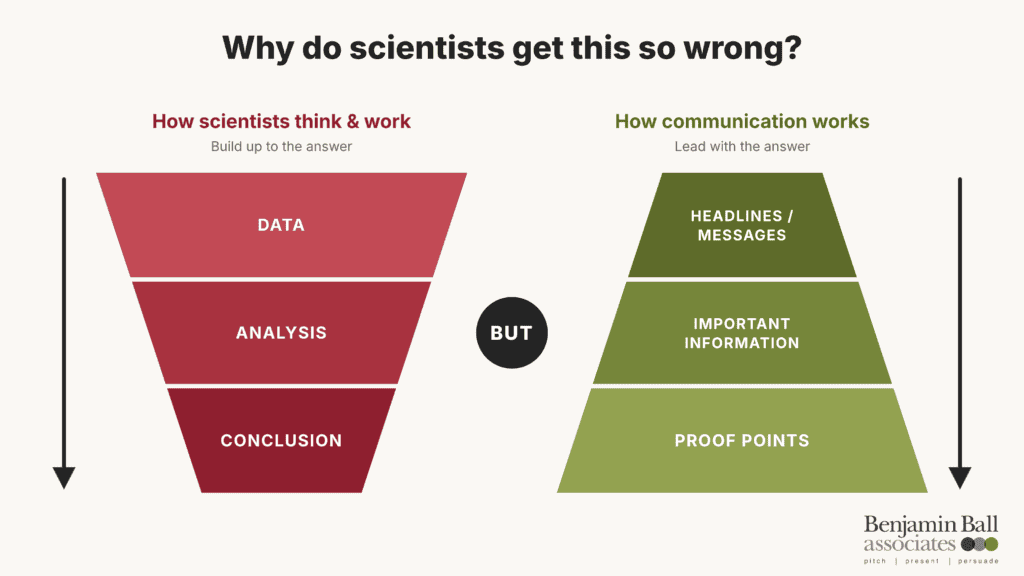
What I regularly see is that scientists are trained to communicate with other scientists. That means papers start with background, move through methods and results, and only reach the conclusion at the end. Every claim is carefully qualified. That is exactly right for a scientific journal or a detailed discussion.
BUT, this approach is wrong for most other audiences. A finance director, a minister, an investor or a journalist wants the conclusion first, in plain language, with just enough evidence to trust it.
The curse of knowledge
The more you know about a subject, the harder it is to remember what it was like not to know it. Terms that feel everyday to you, such as “statistically significant”, “in vitro” or “confidence interval”, can lose a non-specialist audience in seconds.
As a scientific communicator, your job is to explain the most complex ideas in the simplest way possible. This is not dumbing down, it is making your work easy for others to understand.
“The real problem in speech is not precise language. The problem is clear language. The desire is to have the idea clearly communicated to the other person. It is only necessary to be precise when there is some doubt as to the meaning of a phrase, and then the precision should be put in the place where the doubt exists. It is really quite impossible to say anything with absolute precision, unless that thing is so abstracted from the real world as to not represent any real thing.”
― Richard Feynman
The detail dilemma
Our own research found that technical specialists face a particular challenge: deciding how much detail to give non-specialists. Too much and the message is lost. Too little and they worry about looking superficial. Read more in our 2026 research report, From Expertise to Influence.
The caveat trap
Scientific honesty means acknowledging uncertainty. But a presentation where every sentence carries a caveat leaves the audience unsure what you think. The skill is to state your conclusion clearly, then explain the uncertainty once, in proportion.
Confidence under pressure
Many scientists are comfortable at a lab meeting but less so in front of a board, an investment committee or a camera. In our research, confidence was the most common communication challenge among senior professionals, ahead of every other issue.
Why it is so easy for scientists to learn to communicate clearly
Having been coaching for over 20 years, I find scientists are often the best people to work with. Because communication skills are learned skills, our logical approach to teaching these skills lands well with scientists and technical experts.
We show you how to think about what you want to say; how to structure your arguments and how to deliver confidently and clearly. We can show you everything from ways to start your presentation for impact to skills for handling tough (or stupid) questions.
Get a free quote. Speak to an expert
8 scientific communication skills every scientist needs
1. Define the decision before the data
Before you start preparing any slides, write down who your audience is and what you want them to think, feel or do at the end. Approve a budget? Back a recommendation? Change a policy? Every slide should help them get there.
2. Flip the structure
Instead of background, methods, results, conclusion, try this:
- What we found (the headline) and what we recommend
- Why it matters to this audience
- How we know (just enough evidence to trust it)
- What we recommend or need from you
This is the BLUF approach (bottom line up front), and it works for almost every non-specialist audience. See our guide to presentation frameworks.
3. Write one sentence that sums it up
If you can’t summarise your research in one plain sentence, your audience won’t be able to either. Test it with the So What test: would someone outside your field understand why it matters? For example, I used to test my messages on my 14-year-old daughter. If she can undertsand it, then anyone can.
4. Show less data, more meaning
Use one chart per point, with a headline that says what the chart shows: “Infection rates fell by half within six months”, not “Figure 3: infection rates 2024 to 2026”. Highlight the line or bar that matters, and remove gridlines, legends and labels the audience doesn’t need. Our guide to writing presentation headlines shows how.
5. Translate the jargon
Replace technical terms with everyday words where you can, and explain the ones you can’t keep. “A molecule that switches off the gene” lands better than “a small-molecule inhibitor”.
Example of clear communication from Richard Feynman
“Nothing is really as it seems. Hot and cold is just the speed the atoms are jiggling at. If they jiggle more, it corresponds to hotter, and colder is jiggling less. So if you have a bunch of atoms, a cup of coffee, sitting on a table and the atoms are jiggling a great deal in the coffee, they bounce against the cup and the cup then shakes and they bounce again the saucer.
“The hot thing then spreads its heat into other things by mere contact because the atoms that are jiggling a lot in the hot thing shake the ones that are only jiggling a little bit in the cold thing, so the heat goes into the cold thing – it spreads . But what’s spreading is just jiggling. Which Is easy to understand. “
– Richard Feynman, Fun To Imagine, BBC, (https://youtu.be/P1ww1IXRfTA)
6. Use comparisons and stories
Numbers mean more when they are put in context. “Enough energy to power 50,000 homes” is easier to grasp than a figure in megawatts. A short story about one patient, site or experiment often does more to persuade than a page of results.
7. State uncertainty once, clearly
Give your conclusion with appropriate confidence, then explain the main uncertainty in one place: “We’re confident about the direction of the effect. The open question is how large it will be at scale.” That is more credible than hedging every sentence.
8. Rehearse out loud, including the Q&A
What we always recommend is to present to a colleague from outside your field. If they can tell you your main message afterwards, you’re ready. Then ask them to challenge you with the hardest questions a sceptic might ask. Our guide to rehearsing a presentation sets out a method you can follow.
Presenting science to different audiences
The same research needs a different presentation for each audience. Here are the situations we coach scientists for most often.
| Audience | What they want to know | What works |
|---|---|---|
| Funders and grant panels | Will this work, and is it worth the money? | A clear problem, a credible plan, early evidence and the impact if it succeeds |
| Investors | What’s the commercial opportunity, and can this team deliver it? | The market need first, then the science as proof. See our investor pitch coaching |
| Boards and executive committees | What decision do you need from us, and what are the risks? | A recommendation in the first minute, options with trade-offs, and short answers to challenge |
| Regulators and policymakers | Is it safe, what’s the evidence, and what should we do? | Plain language, balanced evidence, a clear position and calm handling of tough questions |
| Scientific conferences | What’s new, and is it robust? | One central finding, clean visuals and time for discussion |
| The media and the public | What does this mean for me? | A simple headline, a real-world example and no jargon. See our media training |
Presenting to boards and senior leaders
Scientists who move into leadership often find the board the hardest audience of all. Directors are rarely specialists, time is short and every answer is weighed. Lead with your recommendation and what you need, keep the science to what supports the decision, and prepare for questions about cost, risk and timing. Our guide to presenting to the board has more.
Speaking to the media
A journalist will usually use only one or two sentences from an interview. Decide in advance what you want those sentences to be, and say them simply. Avoid speculating beyond your evidence, and be ready to explain what your findings don’t mean, as well as what they do. Read how our tailored media training can help you.
CASE STUDY: preparing a scientist for an assistant professor interview
HIS CHALLENGE: Our client was preparing for an assistant professor interview at a new university. He was well-qualified for the job but knew he was up against other strong candidates who might not have the an impressive research background but were strong communicators.
OUR SOLUTION: We role-played every element of his interview, from a presentation of his research to a sample undergraduate lecture to dealing with tough questions. We improved every aspect of his presentation, including simplifying the science, polishing his answers, and making the lecture stand out from the opening words.
THE OUTCOME: He got the job and has built his career by leading a research team that has published groundbreaking research.
Science communication FAQs
What is science communication training?
Science communication training helps scientists and technical experts explain their work clearly to non-specialist audiences, such as funders, boards, investors, regulators, the media and the public. Our programmes usually cover messaging, structure, data visualisation, delivery and handling questions.
Can scientists really learn to present well?
Yes. Presenting is a skill, not a personality trait. Scientists often make excellent presenters once they learn to lead with the conclusion and cut the detail, because their expertise gives them real authority.
Should scientists simplify their research?
Simplify the language and the structure, not the science. The aim is to make your findings easy to understand without overstating them.
Is one-to-one coaching or group training better for scientists?
One-to-one coaching suits a high-stakes event, such as a funding pitch, a board presentation or a media interview. Group workshops work well for research teams who want shared standards and to practise together.
Can training be delivered online?
Yes. Many scientific teams work across several sites or countries, and live online coaching works well, especially for presenting on video calls.
Turn your expertise into influence
Your research deserves to be understood by the people who can fund it, approve it and act on it. Clear communication is how that happens.
At Benjamin Ball Associates, we coach scientists, engineers, and technical specialists to present their work clearly and confidently. Our coaching is bespoke, built around your real presentations and audiences, and delivered one-to-one or with teams, in person in London, at your offices or online.
Get a free quote. Speak to an expert
What you should do next
- For more articles like this, subscribe to our fortnightly newsletter
- Download some of our free expert guides
- Get in touch to discuss how our communication skills coaching and executive presentation coaching can help you and your team.
Call our client services director Louise Angus on +44 20 7018 0922 or email info@benjaminball.com
Get a free quote. Speak to an expert
Why Choose Us:
Transform your pitches and presentations with tailored coaching

We can help you present brilliantly. Thousands of people in the UK, Europe and the Middle East have benefitted from our tailored in-house coaching and advice – and we can help you too.
“I honestly thought it was the most valuable 3 hours I’ve spent with anyone in a long time.”
Mick May, CEO, Blue Sky
For 15+ years we’ve been the trusted choice for leading businesses and executives throughout the UK, Europe and the Middle East. We’ll help you improve corporate presentations through presentation coaching, public speaking training and expert advice on pitching to investors. And we stand out because you benefit from our tried and tested PitchPointTM Process to make sure you make fast and lasting improvements.
Some recent clients

Unlock your full potential and take your presentations to the next level.
Speak to Louise on +44 20 7018 0922 or email info@benjaminball.com to transform your speeches, pitches and presentations.
Get a free quote. Speak to an expert


Contact us now for free consultation
Start improving your pitches and presentations now
Contact us now and speak to an expert about getting award-winning coaching, training and advice