
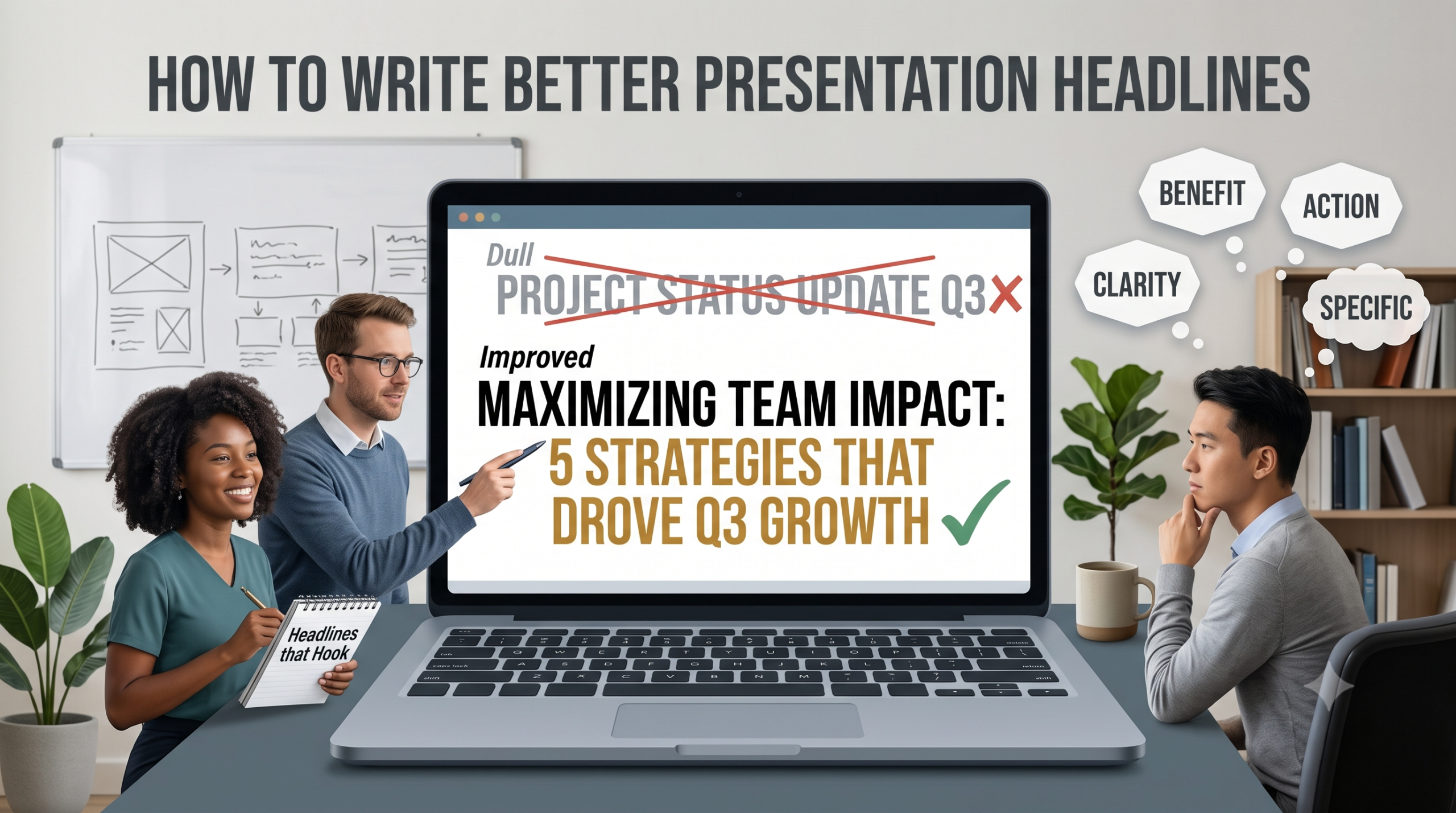
How to Write Presentation Headlines, Slide Titles and Report Headlines That Get Read
July 15, 2026
Updated 12 October 2026
Think about the last report you read or the last corporate presentation deck you sat through. How quickly did you zone out? Many decks are topped with the same safe, forgettable slide titles: “Executive Summary”, “Market Overview” or “Financial Update”.
Those are not headlines. They are labels. And when every slide starts with a label, your audience must work to find the point.
Labels are passive. They tell the audience the topic, but they do not tell them what’s important or why they should care.
If you want to capture your audience’s attention and keep them engaged, your slide headlines must do the heavy lifting. They should tell the story of your slide instantly, even if someone is skimming the page.

Meet the Author: Benjamin Ball
Ben is the founder of London-based Benjamin Ball Associates. He leads the presentation coaching and pitch deck creation teams. Formerly a corporate financier, for 20+ years he’s helped businesses pitch, present & persuade. He is a guest lecturer at Columbia Business School, Imperial College and UCL London. Follow Ben on LinkedIn or visit the contact page.
In this guide, we will look at how to turn flat slide titles into message-led presentation headlines that tell the reader what matters before they study the detail. This is based on our 15 years of experience coaching executives to write and deliver compelling, confident presentations and reports.
The simplest way to write a better presentation headline is to replace a passive label with a complete message. Stop naming the topic. Instead, state the conclusion, action or insight the audience should remember. A strong slide headline answers the reader’s “so what?” before they look at the supporting detail.
Get a free quote. Speak to an expert
Top Tips to Write Better Presentation Headlines
1. Turn Labels into Active Messages (The “So What?” Rule)
Every slide in your deck, and every major section in your report, needs a job to do. If it does not move the argument forward, cut it. The presentation headline should capture that job by answering the question your audience is already asking: “So what?”
When you look at a paragraph or a draft slide, ask yourself: What is the single most important takeaway here? That main point—the absolute core of your key messages—is your new headline.
A good presentation headline does more than name the topic. It makes a specific assertion, gives the reader a reason to care and points them towards the evidence on the slide.
| Before (The Label) | After (The Active Message) |
| Q3 Operational Expenses | Q3 Expenses Rose by 12% Due to Higher Offshore Logistics Costs |
The first version makes your audience do the hard work. Your reader needs to study the chart and expend effort to understand what you are saying.
With the second version, you have done the work so that it is easier for your reader. Your headline tells them exactly what the trend is. They can now look at the data to find the evidence, rather than having to discover the point themselves.
We discuss this approach to structuring your message in detail in our Ultimate Guide to Business Presentations.
2. Make Your Document Scannable
A brilliant presentation should be like a story. If a busy board member flips through your report or printed deck and reads only the presentation headlines, they should still understand your entire presentation from start to finish.
If your presentation headlines say Introduction, Background, Our Solution, Financials, and Conclusion, your narrative is completely lost. To maintain your audience’s interest from the first slide to the last, you must lay out your key points in a logical, scannable progression.
Instead, construct your headlines so they give a logical narrative:
- Slide 1: “The European logistics market is facing unprecedented fuel price spikes.”
- Slide 2: “Our competitors are passing 100% of these costs onto their customers.”
- Slide 3: “We can gain market share by absorbing the cost for key accounts.”
- Slide 4: “A minor margin sacrifice now will secure lucrative long-term contracts.”
This technique (which many management consultancies use) is something we work on closely during our Business Presentation Skills Training.
When your story flows naturally from one slide to the next, your audience can follow the logic without having to piece it together for themselves.
3. Use Strong, Active Verbs
Nouns are heavy and static. Verbs drive action and energy. Learn a trick from newspaper headline writers: to make your headlines punchier, swap passive nouns for active verbs.
Passive (Noun-Heavy): “Implementation of the new HR software.”
Active (Verb-Driven): “Deploying the new HR software cuts admin time in half.”
Action words such as “cuts”, “secures”, “reduces” and “accelerates” help a slide headline sound decisive. Used well, they make your point easier to grasp and give senior decision-makers a clearer reason to keep reading.
4. Align Your Spoken Hook with Your Headline
Your slide headline and your opening sentence should reinforce the same message. If they point in different directions, the audience has to decide which one to follow.
When you introduce a slide, your opening sentence should match the core message written at the top. If your slide headline reads:
“Partnering with Vendor X Cuts Our Delivery Times by 40%”
Do not start by saying: “Now, moving on to our vendor options…”
Instead, start with the headline itself: “We can slash our delivery times by forty per cent if we partner with Vendor X.”
This alignment means your audience will find it easy to understand your narrative. If you struggle with keeping people hooked right from the start, check out our video guide on How to Start Your Presentation with Impact.
5. Keep it Concise (The 15-Word Rule)
While active presentation headlines must contain a complete thought, they should not turn into paragraphs. A good rule of thumb is to keep them under 15 words. Ideally, they should fit on one line of your slide.
If a headline is too long, it clutters your design and distracts the audience. Crafting short headlines means finding the right balance between context and brevity. Trim the fat. Remove unnecessary words and filler phrases like “In order to” (use “To”), or “An analysis of” (simply state the result of the analysis).
Here are a few quick headline makeovers to show the difference:
| Before (The Dreaded Label) | After (The Compelling Headline) |
| Analysis of our current market position in the UK retail sector | We hold 40% of the UK retail market, but competitor growth is accelerating |
| New marketing strategy and proposed budget requirements | A £50k marketing boost will secure our lead in the key London market |
| Global supply chain challenges and their impact on operations | Shipping delays in Asia will delay our winter product launch by three weeks |
What The Science Says
1. Sentence headlines improve recall
Research at Penn State found that audiences shown slides with sentence headlines answered 79% of test questions correctly, compared with 69% for audiences shown traditional topic labels.
Alley, M., Schreiber, M., Ramsdell, K. & Muffo, J. (2006). How the design of headlines in presentation slides affects audience retention. Technical Communication, 53(2), 225–234.
2. A slide that states its point is easier to understand
A follow-up controlled study by Garner and Alley found that audiences comprehended and retained technical content better from slides with a sentence headline supported by visual evidence (the “assertion-evidence” approach) than from conventional topic-and-bullets slides.
Garner, J. K. & Alley, M. (2013). How the design of presentation slides affects audience comprehension: A case for the assertion-evidence approach. International Journal of Engineering Education, 29(6), 1564–1579.
3. Telling people the point first helps them understand and remember
Psychologists have known since the 1970s that people understand and remember information far better when they’re told what it’s about first. A headline that states your point does exactly that. Participants read a deliberately vague passage. Those given its title beforehand (“Washing Clothes”) understood and recalled it far better than those given no title, or the title only afterwards. Context before content is what makes it understandable.
Bransford, J. D. & Johnson, M. K. (1972). Contextual prerequisites for understanding: Some investigations of comprehension and recall. Journal of Verbal Learning and Verbal Behavior, 11(6), 717–726.
4. Clear signposting reduces effort and improves learning
A meta-analysis of 103 studies covering more than 12,000 participants found that cues highlighting how material is organised (such as headings) improved retention and reduced mental effort.
Schneider, S., Beege, M., Nebel, S. & Rey, G. D. (2018). A meta-analysis of how signaling affects learning with media. Educational Research Review, 23, 1–24.
Transform the Impact of Your Presentation
If you want help shaping a clearer story, building confidence and making your next high-stakes presentation easier to follow, our bespoke Executive Presentation Skills Coaching is available in London and online.
For an investor pitch, have a look at our Investor Messaging Cracker Process.
Explore our bespoke Executive Presentation Skills Coaching to work one-on-one with our expert coaches in London or online. Turn your next high-stakes presentation into a major success.
Get a free quote. Speak to an expert
What you should do next
- For more articles like this, subscribe to our fortnightly newsletter
- Download some of our free expert guides
- Get in touch and discuss how our intensive presentation coaching and public speaking training courses can help you.
Call our client services director Louise Angus on + 44 20 7018 0922 or email info@benjaminball.com
Find out more.
Get a free quote. Speak to an expert
Why Choose Us:
Transform your pitches and presentations with tailored coaching

We can help you present brilliantly. Thousands of people in the UK, Europe and the Middle East have benefitted from our tailored in-house coaching and advice – and we can help you too.
“I honestly thought it was the most valuable 3 hours I’ve spent with anyone in a long time.”
Mick May, CEO, Blue Sky
For 15+ years we’ve been the trusted choice for leading businesses and executives throughout the UK, Europe and the Middle East. We’ll help you improve corporate presentations through presentation coaching, public speaking training and expert advice on pitching to investors. And we stand out because you benefit from our tried and tested PitchPointTM Process to make sure you make fast and lasting improvements.
Some recent clients

Unlock your full potential and take your presentations to the next level.
Speak to Louise on +44 20 7018 0922 or email info@benjaminball.com to transform your speeches, pitches and presentations.
Get a free quote. Speak to an expert
Frequently Asked Questions – Better Presentation Headlines and Slide Headlines
What is the difference between a slide title and a slide headline?
A bad slide title names the topic. A good slide headline states the message. “Marketing Budget” and “Regional Performance” are bad titles because they tell the audience what the slide is about, but not what they should take from it.
A good slide headline, on the other hand, is an active assertion. It delivers a message, tells a story and explains exactly why the slide matters.
Bad Slide Title (Passive Label): “Customer Retention Statistics”
Good Slide Headline (Active Message): “Customer churn dropped to an all-time low of 2 per cent this quarter”
If you are aiming to build a deck that lands your message instantly, every slide should lead with an active headline. To see how this fits into the overall design of your deck, read our 10 top tips on what makes a good presentation.
How do you write action titles in PowerPoint slides?
To write dynamic action titles, you need to swap weak nouns for energetic verbs and include specific, quantifiable results.
Instead of writing what the slide is, write what the slide does or shows.
Here is a simple three-step method to transform your titles:
Identify the core result: What is the most important change or outcome on this page?
Lead with a verb: Start with or include a strong action word (e.g., Slashes, Accelerates, Boosts, Exceeds).
Add concrete data: Use a hard statistic or a specific outcome to make the headline indisputable.
Weak Title: “New Recruitment Strategy Progress”
Action Headline: “Our new recruitment strategy reduces hiring time from six weeks to twelve days”
By writing your slides this way, your audience does not have to hunt for the point. If you want to refine your drafting process before you even touch a slide builder, explore our expert guide on how to write a presentation
What is the BLUF approach for presentation headlines?
BLUF stands for Bottom Line Up Front. It is a communication technique that places the most important conclusion right at the start of your message, rather than burying it at the end of a long explanation.
When applied to slide design, the BLUF approach means your headline must state your final conclusion immediately. You should never make your audience wait until the bottom of the page or the end of your talk to find out what you are proposing.
For example, if you are pitching a new IT system:
The slow build-up: “An overview of our legacy IT system costs and potential savings from upgrading to the cloud.”
The BLUF approach: “Upgrading to the cloud will save us £15,000 per month starting from day one.”
This technique means that your audience instantly grasps your intent, even if they only glance at the top of your slides. To learn how to apply this and other structures to your entire talk, browse our guide to powerful presentation frameworks.
How many words should a PowerPoint slide headline be?
The ideal headline length is between 8 and 15 words. It needs to be long enough to form a complete, grammatically correct sentence with a verb, but short enough to fit comfortably on a single line.
If a headline wraps onto a second or third line, it crowds the page and makes the slide look cluttered. To keep your headlines concise, edit out redundant corporate phrases.
Wordy (21 words): “Our team conducted a thorough analysis which shows that we must invest in automated sorting machines to double our daily output.”
Concise (11 words): “Investing in automated sorting machines will double our daily output.”
Keeping headlines brief forces you to choose the one point the audience must remember.
That is what gives a presentation pace: each slide advances the argument instead of asking the reader to search for it.
What you should do next
- For more articles like this, subscribe to our fortnightly newsletter
- Download some of our free expert guides
- Get in touch and discuss how our intensive presentation coaching and public speaking training courses can help you.
Call our client services director Louise Angus on + 44 20 7018 0922 or email info@benjaminball.com
Find out more.
Get a free quote. Speak to an expert
Related Posts


Contact us now for free consultation
Start improving your pitches and presentations now
Contact us now and speak to an expert about getting award-winning coaching, training and advice