

How to Write a Board Report – 12 Top Tips
September 23, 2025
Updated 18 September 2026
A well-written board report gets decisions made. A poorly written one gets skimmed, misunderstood, or ignored.
Board members are busy. They’re reading your report on a train, between meetings, or late at night after the kids are in bed. If you bury your recommendation on page four, they may never find it. If you drown them in operational detail, they’ll lose the point.
This guide gives you 12 practical techniques to improve board report writing so that you write board reports that get read, understood, and acted on. This is based on more than 15 years of helping senior executives communicate with their boards.
Learn how our tailored report writing training can help you.

Meet the Author: Steve Jacobs
Steve is a partner at Benjamin Ball Associates, leads the writing team and is an outstanding coach and trainer. Steve has more than 25 years’ experience in corporate and financial public relations. He was a founding partner of the strategic comms division of FTI and more recently was head of comms and IR at Breedon Group plc. Follow Steve on LinkedIn or visit the contact page.
I love writing. I’ve been doing it all my life and have helped hundreds of clients either by writing clear, authoritative text, or coaching them how to do it themselves. Here I share with you some of my top tips to write a board report that makes an impact.
What Board Members Actually Want From Your Board Report
Before you write a word, understand what directors are looking for:
- The recommendation — What do you want them to decide?
- The rationale — Why is this the right choice?
- The risks — What could go wrong, and how will you manage it?
- The numbers — What does it cost, and what’s the return?
- The ask — What specific action do you need from them today?
Everything else is supporting detail. If it doesn’t help the board make a decision, it belongs in an appendix—or nowhere.
What Makes a Board Report Work?
Effective board reports that follow best practice share three qualities:
- Clear — The recommendation and rationale are obvious within 60 seconds
- Brief — Every sentence earns its place; detail lives in appendices
- Actionable — The board knows exactly what decision you need and why
Most weak reports fail on all three. They bury the ask, include too much operational detail, and leave directors wondering, “What do you actually want us to do?”
These 12 best practice board report writing techniques will help you avoid those traps.
We’ve supported management teams to write better board reports for over 15 years. If you’d like to discuss our fast, effective board report writing coaching programmes, get in touch today.
Get a free quote. Speak to an expert
12 Steps For Writing Better Board Reports
1. Lead with the Bottom Line (BLUF)
Top tip: Bottom Line Up Front: start with a concise executive summary that delivers your key message, recommendations and required actions upfront.
Why it’s important: board members are time-poor and interested in what will make a difference. They need to grasp the essence of the issue immediately. Don’t make them hunt for the “so what?” Burying the lead risks them missing your core point or, worse, misunderstanding the situation. Structure the entire report to support this initial conclusion.
| WEAK START: | STRONG START: |
| “We have conducted extensive research and determined that there are various issues we need to deal with.” | “We recommend improving customer experience by investing £0.5m in a new software platform. This will deliver the following benefits….” |
2. Write for scanners, not just readers
Top tip: Your board report should be as easy to read as a newspaper
Why it’s important: many board members will skim the report first. A dense, monolithic block of text is intimidating and inefficient. Visual signposts allow them to quickly navigate to the sections most relevant to them, understand the flow of your argument and absorb information efficiently.
Make your presentation headlines do the hard work.
| POOR STRUCTURE | GOOD STRUCTURE |
| A large block of text that contains a lot of information but is hard to read and forces the reader to read everything. When faced with this your reader is more likely to switch off and ignore what you’ve spent time writing. | Clear headlines. Easy to scan. Shouts the message from quick-to-read headlines. |
3. Talk about strategic impact, not operational detail
Top tip: filter every piece of information through a strategic lens. Ask: “Why does this matter to the board’s governance, risk and business duties?” Cut detail that belongs in an appendix or operational review.
Why it’s important: the board’s role is governance and long-term strategy. They trust you to run the operations. Flooding them with granular data dilutes your key messages and wastes their limited attention. Show them the forest, not every tree.
| WEAK WRITING | STRONG WRITING |
| “By deploying the new AI-3457J code in base system sub-routines and then transitioning to version 32.45 of the operating system, we’ll reduce lag in the central bus and optimise the SE-54 frameworks.” | “These software changes will reduce the risk of hacking and increase system up-time.” |
4. Be objective and data-driven when you write board reports
Top tip: back up your assertions with data, evidence and objective analysis. Clearly separate fact from opinion. Use charts and graphs to visualise data, but make sure they’re simple and clearly labelled.
Why it’s important: credibility is your most important currency. Board members need to trust that the information you provide is accurate. Data provide an objective foundation for discussion and decision-making, moving the conversation from “I feel” to “The evidence shows.”
| WEAK WRITING | STRONG WRITING |
| “We think sales will increase and customer service will be improved with these changes.” | “This change should increase sales by 10% and increase our customer satisfaction score by 15% within six months.” |
5. Clearly state risks and mitigations
Top tip: identify and assess the risks associated with your proposal or update. Don’t hide challenges; demonstrate foresight by presenting a clear plan to mitigate them.
Why it’s important: the board’s job is to oversee risk. So, discuss risks to build trust. This will help disarm objections.
| Risk | Likelihood | Impact | Mitigation |
|---|---|---|---|
| Supplier delay | Medium | Schedule slips 4 weeks | Dual-source from Q2; penalty clauses |
| Staff resistance | Low | Slower adoption | Change management programme; early engagement |
6. Define ‘the Ask’ explicitly
Top tip: be crystal clear about what you’re asking the board to do. Is it a decision, an endorsement, or simply “for noting”? State the required action clearly.
Why it’s important: ambiguity leads to inaction or misalignment. A clear ‘ask’ focuses the board’s discussion, streamlines the decision-making process and ensures there’s no confusion about the outcome you need from them.
| WEAK WRITING | STRONG WRITING |
| “The background to this request is a concern by various team members that the systems we are using are not optimised, so we conducted a thorough analysis of our operations compared to market best practice.” | “We propose investing £200k on upgrading the customer service system to ensure 99.9% availability, matching industry best practice.” |
7. Maintain a confident, concise tone
Top tip: use strong, active language and avoid hedging, jargon and corporate buzzwords. Be direct and authoritative.
Why it’s important: your language reflects your leadership. Wordy, hesitant or jargon-filled prose will undermine confidence in your command of the subject. Be concise and clear.
8. Anticipate questions and pre-empt them
Top tip: think like a board member when writing board reports. What questions would you have? Address the obvious ones within the report itself, especially potential objections or alternative viewpoints.
Typical questions include:
- What happens if we don’t do this?
- What alternatives did you consider?
- What’s the downside scenario?
- Who’s accountable for delivery?
- How will we measure success?
Why it’s important: Better board report writing demonstrates thorough preparation and strategic thinking. It short-circuits basic clarifying questions during the meeting, allowing the discussion to focus on higher-level strategic debate rather than filling in information gaps.
| WEAK APPROACH | STRONG APPROACH |
| Ignore objections and questions. | “We understand that some people are sceptical about this change. Some question whether the technology is tested and whether it is right for our business. Our analysis shows that this is the right approach, and here is why.” |
9. Use the ‘active voice’
Top tip: structure sentences so the subject performs the action (active), not receives it (passive).
Why it’s important: the passive voice can obscure responsibility and feel evasive, which undermines trust. The active voice is stronger, more direct and uses fewer words. It creates accountability by making it clear who did what.
| PASSIVE VOICE | ACTIVE VOICE |
| “A study was commissioned to engage stakeholders and identify focus points.” | “We commissioned a study to find out where our customers needed more support.” |
10. Eliminate weasel words and hedging language
Top tip: avoid qualifiers that weaken your conviction, such as “I think,” “we believe,” “it might be possible,” “somewhat,” “generally” and “virtually.” State facts and recommendations with confidence in your board report writing.
Why it’s important: the board relies on you for definitive advice and analysis. Hedging language sounds uncertain and can seed doubt. State your case based on the evidence you have.
| WEAK WRITING | STRONG WRITING |
| “We believe this strategy could potentially drive growth.” | “This strategy will drive growth” or “This strategy is projected to drive 5% growth.” |
11. KISS, KYSS
Top tip: brevity is a superpower. Keep it Short and Simple. Keep Your Sentences Short.
Why it’s important: board members have limited time. Board agendas are packed. It’s your job to make it easy for them. That means you need to do the hard work so it’s easy for them to understand. Sharp board report writing demonstrates sharp thinking.
| WEAK APPROACH | STRONG APPROACH |
| “In this 50-page report we lay out the various options open to the board and the pros and cons of each.” | “We recommend keeping the current system running for at least another two years and reassess at that time. This will defer capex and reduce the need for outside consultants. Our analysis shows that the risks are minimal.” |
12. Avoid common board report writing mistakes
What are common mistakes when writing board reports?
During our team’s 15+ years helping people write better board reports, we’ve repeatedly seen the following mistakes:
- Not getting to the point
- Death by PowerPoint
- Too much detail
- Unclear recommendations
- Ugly documents that are hard to read
- Failing to address what most interests the board
The art of writing a good report is a core management skill and one that you need to master. We can help you do that through our intensive masterclasses and board report writing training session
Putting it all together: a Before and After example
See how better board report writing makes a big difference.
WEAK (passive, wordy, vague): STRONG (active, specific, decision-ready): It is believed by the leadership team that a strategic pivot might be necessary due to the fact that market conditions have been somewhat volatile. It is recommended that we should consider the possibility of reallocating resources in a very quick fashion to better areas of opportunity.”
“Volatile market conditions require a strategic pivot. We recommend reallocating £2m from Project Alpha to Project Beta before Q4 to capture this higher-growth opportunity. Expected incremental revenue: £5m over 18 months.”Problems:
Passive voice obscures who believes what
“Might be necessary” and “consider the possibility” are hedge words
No numbers, no timeframe, no clear askWhy it works:
Active voice (“We recommend”)
Specific numbers and dates
Clear action the board can approve
NB: The second version is shorter, more confident and provides the board with a clear, actionable recommendation grounded in specific data. This is the standard that earns trust and drives decisions.
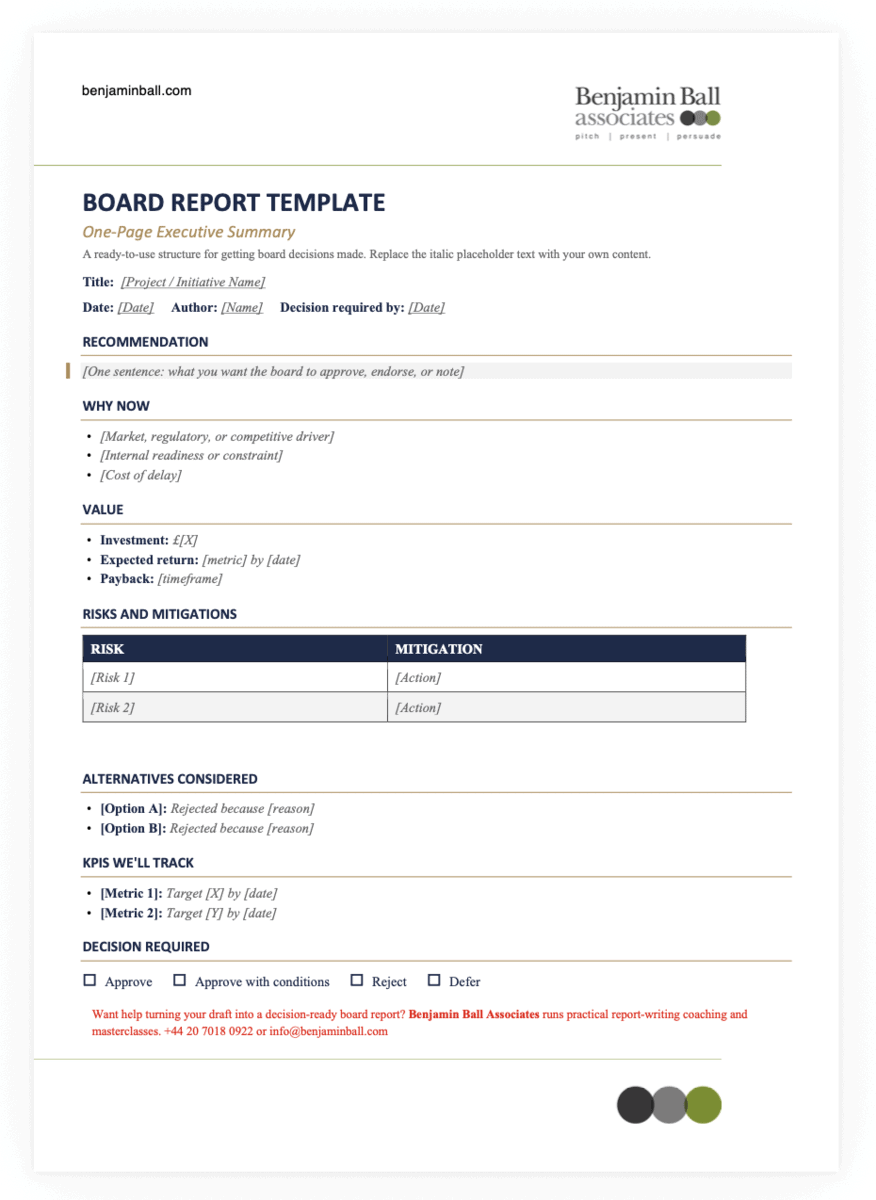
Board Report Template: One-Page Executive Summary
Title: [Project/Initiative Name]
Date: [Date] | Author: [Name] | Decision required by: [Date]
Recommendation [One sentence: what you want the board to approve/endorse/note]
Why now
- [Bullet 1: market/regulatory/competitive driver]
- [Bullet 2: internal readiness or constraint]
- [Bullet 3: cost of delay]
Value
- Investment: £[X]
- Expected return: [metric] by [date]
- Payback: [timeframe]
Risks and mitigations
Risk Mitigation [Risk 1] [Action] [Risk 2] [Action] Alternatives considered
- [Option A]: Rejected because [reason]
- [Option B]: Rejected because [reason]
KPIs we’ll track
- [Metric 1]: Target [X] by [date]
- [Metric 2]: Target [Y] by [date]
Decision required ☐ Approve ☐ Approve with conditions ☐ Reject ☐ Defer
Download a Board Report Template
What next for better board report writing?
If you’d like to improve your board reporting and get best-practice board report writing skills in your team, get in touch. Whether a small-group coaching session, or a larger masterclass, we can help build skills in your team.
Speak to Louise Angus, our client services director today.
Get a free quote. Speak to an expert
What you should do next
- For more articles like this, subscribe to our fortnightly newsletter
- Download some of our free expert guides
- Get in touch and discuss how our intensive report writing training and public speaking training courses can help you.
Call our client services director Louise Angus on + 44 20 7018 0922 or email info@benjaminball.com
Find out more.
Get a free quote. Speak to an expert
Why Choose Us:
Transform your pitches and presentations with tailored coaching

We can help you present brilliantly. Thousands of people in the UK, Europe and the Middle East have benefitted from our tailored in-house coaching and advice – and we can help you too.
“I honestly thought it was the most valuable 3 hours I’ve spent with anyone in a long time.”
Mick May, CEO, Blue Sky
For 15+ years we’ve been the trusted choice for leading businesses and executives throughout the UK, Europe and the Middle East. We’ll help you improve corporate presentations through presentation coaching, public speaking training and expert advice on pitching to investors. And we stand out because you benefit from our tried and tested PitchPointTM Process to make sure you make fast and lasting improvements.
Some recent clients

Unlock your full potential and take your presentations to the next level.
Speak to Louise on +44 20 7018 0922 or email info@benjaminball.com to transform your speeches, pitches and presentations.
Get a free quote. Speak to an expert
Great feedback from our clients
FAQ: How to write a board report and improve board reporting
What is the purpose of a board report?
To help directors make a clear decision. Your job is to present the bottom line, support it with evidence, and spell out exactly what you want them to do.
How long should a board report be?
Shorter than you think. Put the headline points in the first page, move detail to appendices, and keep sentences tight. If a paragraph can be a bullet, make it a bullet.
What structure works best?
A simple flow:
– Executive summary and recommendation
– Strategic impact and context
– Options considered and why you chose this one
– Risks and mitigations
– Cost, benefits, and KPIs
– The Ask restated (what decision you need)
What KPIs should I include?
Only the ones that prove your case. Choose 3–5 measures you’ll track after approval, with targets and timing. Example: revenue +10% by Q3, CSAT +15% in six months, churn −2 pts by year end.
What’s the best way to present options?
Show the shortlist and why you rejected or selected each one. A quick table works: Option, pros, cons, cost, risk, recommendation.
How do I avoid “death by PowerPoint”?
Use word. Or keep slides visual and minimal. One message per slide, a clear headline, and a simple chart or figure. Put the narrative in the paper, not on the slide. Read how to avoid death by PowerPoint
How do I format for readability?
Use 12–12.5pt body text, generous line spacing, meaningful headings, consistent styles, and numbered pages. Perhaps lay out as 2 columns with headings in left hand column.
What should go in the appendices?
Operational detail, technical specs, full financial models, research notes, legal wording. Keep the core paper focused on decisions and outcomes.
How do I close the report?
Repeat the decision required and next steps with owners and dates. Example: “If approved, procurement starts Monday. Jane leads vendor selection. First milestone review in four weeks.”
How can you help my team improve board reports?
We run practical report writing coaching and masterclasses that turn long, vague papers into sharp, decision-ready reports. If you’d like quick feedback on a live draft, we can review and sharpen it with you.
What you should do next
- For more articles like this, subscribe to our fortnightly newsletter
- Download some of our free expert guides
- Get in touch and discuss how our intensive report writing training and public speaking training courses can help you.
Call our client services director Louise Angus on + 44 20 7018 0922 or email info@benjaminball.com
Find out more.
Get a free quote. Speak to an expert
Related Posts


Contact us now for free consultation
Start improving your pitches and presentations now
Contact us now and speak to an expert about getting award-winning coaching, training and advice