What Investors Look For In a Pitch – Top Tips for Founders and Teams
October 19, 2024
Updated 20 August 2026
What do investors want from your pitch and your pitch book?
If you are you a business looking to raise money, your pitch will decide whether you stand out. If you understand what investors want from a pitch deck, then you’ll find it easier to win investment.
Here our expert coaches, who have written hundreds of pitch decks, share insights into what investors want and what they expect from you.
Ben is the founder of London-based Benjamin Ball Associates. He leads the presentation coaching and pitch deck creation teams. Formerly a corporate financier, for 20+ years he’s helped businesses pitch, present & persuade. He is a guest lecturer at Columbia Business School, Imperial College and UCL London. Follow Ben on LinkedIn or visit the contact page.
What Investors Look For In A Pitch Deck
Put simply, the key things investors want from a company pitch is:
A clear, large problem that is well understood
A compelling solution that only you can execute
A large market size
Competitive advantages that set you apart from others and build barriers to entry
Evidence of traction
A strong management team
A scalable business model
Clear financial projections
A realistic funding ask
Pitching To Investors and Raising Investment is Hard
It’s not easy securing investment for a business – the right investors are inundated with pitches. So you must have a compelling and well-structured pitch presentation.
At Benjamin Ball Associates, we have been helping businesses of all sizes pitch to investors for 15 years.
We’ve probably created more than 200 investor pitch decks and been involved in hundreds of billions of investment. We help firms pitch to institutional investors, venture capitalists and to PE. We craft powerful investment stories, create compelling investor pitch decks and coach management teams to impress investors.
Based on our experience, here’s a guide to what investors look for in a pitch deck and the best way to craft a presentation that addresses the most important factors that resonate with potential investors.
What Investors Look For in Your Pitch
Let’s look at each of these essential tips in more detail:
1. Have a Clear Problem Statement
What Investors Look For: A definition of the problem you solve
Investors want to know that your business addresses a real and significant problem. To increase investor interest, your pitch deck should articulate the problem clearly and succinctly. You should aim to teach the investor about your industry so that they clearly grasp the issues your clients face.
How to Present:
– Start with a compelling story or statistic that highlights the issue your product or service solves.
– Clearly outline why this problem matters and who is affected by it. Demonstrate a large market and use case studies.
Example of what investors look for
A few years ago we helped a tech business that was selling an automated KYC (Know Your Customer) solution for banks. We dedicated the first few pages of the investor pitch to explaining what the KYC problem was, how much it costs the banks and how long it took.
Then, as they described their solution, investors could understand it was a great idea and the value-add of the business.
2. Be Clear About Your Solution & Unique Value Proposition
What Investors Look For: What Sets You Apart
Your unique value proposition (UVP) explains how your solution stands out from the competition. Investors want to see that your business offers something that is not only innovative but also valuable.
How to Present
– State what makes your product or service unique. This could be innovative technology, a superior user experience,or a disruptive business model.
– Use comparative analysis to show how your offering outperforms existing solutions or how customers can be won easily.
Example
In the KYC example above, we compared the time and effort the automated KYC solution saved vs the current manual approach that most banks used, thereby showing investors the obvious reason that customers were buying this new technology.
3. Define the Market Opportunity Size
What Investors Look For: Size and Growth Potential
Investors are interested in the market opportunity. They want to know the size of your target market and its growth potential.
How to Present
– Provide data on the current market size and projected growth rates. Use reputable sources and market research to back your claims.
– Segment your market and identify your ideal customer profile. If you can show how you are winning in one segment, it will add extra credibility to how you’ll win in other areas.
Example
As well as showing the usual TAM, SAM, SOM type statistics, you can add additional credibility by looking at the market in various ways. For example, what share of the current market do you have now? How fragmented is the market? What is a realistic goal you might reach? The better your potential investor understands your market, the more likely they’ll believe your projections.
4. Outline Your Business Model
What Investors Look For: How You Make Money
A clear and scalable business model is crucial for attracting investment. Investors want to see how you generate revenue and achieve profitability. Show them what people pay, how often they need to make buying decisions, how loyal they are.
How to Present
– Describe your revenue streams, whether they’re from subscriptions, licensing, or transactional sales.
– Include pricing strategies and your plans for additional monetisation.
– If appropriate, share standard metrics such as ARR, MRR, Churn, CAC etc
Example
A recent client of ours omitted this element from their pitch.
After we worked with them, they showed investors that clients stuck with them for 10+ years, that each year they were able to grow existing clients, they had very low churn, and that new clients could be won inexpensively. With this information, the business was even more attractive to investors.
5. Show Traction and Milestones
Demonstrate Progress
Showing that your business is gaining traction can significantly strengthen your presentation. Investors want evidence that your product/service is working, you have a strong track record and that numbers are moving in the right direction.
How to Present
– Share key milestones you have achieved, such as product development stages, user acquisition metrics, or revenue figures.
– Use charts and graphs to illustrate growth and progress visually.
Example
Recently, a client of ours needed help to show the progress they were making. We developed a simple table showing where they were two years ago and where they were now. From this table it was clear how fast the business was growing, how they grew EBITDA faster than revenues and how successful they had been in growing market share.
6. Give an Analysis of the Competition
What Investors Look for: An Understanding the Landscape
Prospective investors want to see that you understand the competitive landscape and are clear why you stand out and have a competitive advantage vs the competition.
How to Present
– Provide a competitive analysis that outlines key players in your market, their strengths and weaknesses, and your differentiators. A 2×2 matrix can be a powerful way to show how you stand out from the competition.
– Highlight barriers to entry that protect your firm from competitors.
– Consider a table showing how your offer differs from the competition
Example
One client of ours, a Romanian software business, struggled to demonstrate how they stood out from the competition. All the data was there, but it was clumsily laid out in poorly thought out graphs. In the end we took the data and laid it out in one graph that immediately demonstrated that the company was double the size of the nearest competitor and was growing faster that anyone else. It was compelling and convincing.
7. Explain Your Sales, Marketing and Distribution Strategy
What Investors Look for: How You Reach Your Customers
A well-defined sales plan, marketing plan and distribution strategy shows investors how you reach your target customers and scale your business. Finding customers and persuading customers is the hardest part of any business. The more you can reassure investors that you really understand this part of the business is key.
How to Present
– Outline your marketing and sales strategies, including channels, tactics, and partnerships.
– Discuss any existing relationships with distributors or platforms that will help accelerate your market traction.
Example
One client we worked with last year had a complex sales system. They had re-sellers, introducers and direct sales. They operated internationally and they had made many changes over the years. You needed a cold towel over your head to understand what was going on and what was working.
We helped them simplify the story with a clear one page diagram that illustrated their three routes to market. We could then show the value of each of the three routes, evidenced by recent wins.
8. Demonstrate a Strong Team
Showcase Your Expertise
Investors often invest in teams as much as in ideas. A strong team with relevant experience will build confidence in your business.
How to Present
– Introduce your team members, highlighting their backgrounds and expertise, particularly in the tech industry.
– Include any notable achievements or experiences that position your team to succeed.
– Include relevant companies they have worked for that will add credibility.
Example
The team slide in a pitch deck is frequently made over-complicated. One model we frequently use is to show photos of key people, their role in the business, how long they have been there and their previous employers. This frequently gives investors the overview they are looking for.
9. Be Clear How An Investment Will Be Used
What’s Your Plan?
You want to demonstrate a clear plan for investment. That means showing where you are investing, when and what you expect to get from that investment. The more tangible your plans, the more credible they will appear.
How to Present
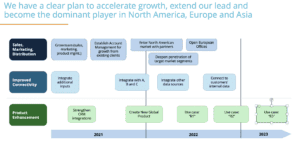
– Show a timeline of the areas in which you need to invest, what you want to achieve and when
– Be clear about the value investment will add to the business.
Example
Here’s an extract from a recent high quality pitch we created for a client. It shows the main areas of investment and the main projects that will be delivered with the new investment.
10. Don’t Avoid Discussing the Risks
Why Risk Matters
Every business has risks, and an investor’s job is to properly understand and quantify those risks. If you say there are few risks, then it sounds as if you don’t properly understand your business. A great way to impress is to be clear about the risks your business faces.
How to Present
– Identify the risks your business faces and describe what you are doing to mitigate those risks
– Quantify any particularly large risks and have to hand the numbers so you can ask questions.
It’s imperative to be able to discuss these risks professionally. Remember, all businesses have risks. You need to show you recognise them and have plans in place to mitigate them.
11. Have Clear Financial Projections
The Numbers Matter
Investors will scrutinise your financial plan to assess the potential return on their investment. Don’t just show financial statements; summarise your financial information and make it easy to understand.
How to Present
– Provide realistic and financial projections for the next three to five years, including market potential, revenue, expenses, and profit margins.
– Clearly explain your assumptions and how they align with market trends, your market share and your business strategy.
Example
We regularly dissuade our clients from showing detailed forecasts. Few investors want to get into the weeds until much later in the investment process. Instead, we help them show simply and graphically how the business will grow, what major changes are expected and how key numbers can be monitored.
12. Have a Clear Call to Action
What You Want from Investors
At the end of your presentation, be clear about what you’re asking for. Whether it’s a specific amount of investment or an introduction to a potential partner, a strong call to action helps guide investors.
How to Present
– Clearly state the amount of funding you are seeking and how you plan to use it.
– Outline the benefits for investors, including projected returns or exit strategies.
Example
If you can say it as simply as: “We are seeking a $5,000,000 investment to expand our development team and enhance our marketing efforts, with the goal of achieving a 5x return within five years”, you’ll be doing well.
13. Get Professional Help to Prepare Your Investor Pitch
Why You Need Help
As a management team, you are probably speaking to investors just a few times in your careers. Whereas professionals prepare management teams to speak to investors every day. Not taking expert advice during the process would be like a professional sportsperson refusing the advice of their coach.
Example of How to Impress Investors
When we support management teams who are pitching to prospective investors, we often help them with a three stage process.
Why Choose Us: Transform your pitches and presentations with tailored coaching
We can help you present brilliantly.Thousands of people in the UK, Europe and the Middle East have benefitted from our tailored in-house coaching and advice – and we can help you too.
“I honestly thought it was the most valuable 3 hours I’ve spent with anyone in a long time.”
Mick May, CEO, Blue Sky
For 15+ years we’ve been the trusted choice for leading businesses and executives throughout the UK, Europe and the Middle East. We’ll help you improve corporate presentations through presentation coaching, public speaking training and expert advice on pitching to investors. And we stand out because you benefit from our tried and tested PitchPointTM Process to make sure you make fast and lasting improvements.
Some recent clients
Unlock your full potential and take your presentations to the next level.
Speak to Louise on +44 20 7018 0922 or email info@benjaminball.com to transform your speeches, pitches and presentations.
Frequently Asked Questions: What Investors Look For in a Pitch
How do I create a clear problem statement for an investor pitch?
To capture interest immediately, you must define the “pain point” your business resolves. A clear problem statement for an investor pitch should use a compelling story or specific statistic to illustrate the issue. If investors don’t grasp the problem, they won’t value your solution.
How should I present a unique value proposition to venture capitalists?
When you present a unique value proposition (UVP), you must move beyond “innovation” and focus on “viability.” Investors want to see a comparative analysis: how does your offering outperform current solutions? Whether it is a superior user experience or a disruptive business model, your UVP must clearly state why a customer would switch from a competitor to your brand today.
How do you define market size (TAM, SAM, SOM) in an investor presentation?
To define market size in an investor presentation effectively, you must go beyond generic figures. While showing your Total Addressable Market (TAM) is standard, sophisticated investors are more interested in your Serviceable Obtainable Market (SOM). Provide credible data on your current market share and a realistic roadmap for growth. Fragmentation in the market can often be presented as an opportunity for a dominant new player to provide a tailored approach.
What traction metrics do investors want to see in a pitch deck?
Investors look for “the red thread” of progress. Key traction metrics investors want to see include a reduction in Customer Acquisition Cost (CAC), improved churn rates, and growth in Annual Recurring Revenue (ARR). Use visual charts and graphs to illustrate that your numbers are moving in the right direction, proving that your business model is gaining genuine momentum.
Why should I include business risks in my investor pitch?
It may seem counterintuitive, but you should always include business risks in an investor pitch. Professional investors are risk-managers; if you claim there are no risks, it suggests you don’t fully understand your industry. By identifying risks and—crucially—explaining your mitigation strategies, you build trust and demonstrate the maturity of your management team.
How should I present financial projections for a 3 to 5-year plan?
When you present financial projections for a 3 to 5-year plan, being clear is more important than exhaustive detail. Summarise your revenue, expenses, and gross margins, but be prepared to defend your assumptions. In 2026, investors are particularly focused on the path to profitability, so ensure your projections align with current market trends and your specific marketing and distribution strategy.
Why should I use a pitch coach for my Series A or IPO?
Pitching is a high-stakes skill that most executives only use a few times in their careers. A London-based pitch coach like Benjamin Ball provides a dispassionate, expert perspective. We help management teams survive rigorous due diligence by preparing them for the “unanswerable” questions and ensuring their delivery is as polished as their pitch deck. read more about our pitch coaching services
What are the benefits of hiring a professional pitch coach from London?
"We had a good story to tell, but you helped us deliver it more coherently and more positively."
Steve Whitfield, CEO, Eurocamp
“BBA worked”
"BBA worked with me on a major pitch to investors… we secured not one but two investments in the space of 10 days! Thank you."
Amelia Morgan, CEO, Venture Trust
“An amazing use of time that will only help me represent myself and FCA more professionally.”
An amazing use of time that will only help me represent myself and FCA more professionally.
Senior Executive, FCA
“A remarkable communications coach”
a remarkable communications coach. His understanding of corporate communications is unmatched. I highly recommend!
Stephen Muchiri
“Highly recommended”
helped me prepare for a key note speech. This helped for that particular speech and for every other since. Highly recommend.
Azim Khan, MD, AIS Consulting
“Truly fantastic”
"Thank you for today's training session. It was truly fantastic. I feel much more confident in my ability to not only write speeches but also present them effectively."
JG, FCA
“Clear improvements”
"The results speak for themselves — participants consistently show clear improvement and feel empowered to take on their roles as effective speakers.
Even during long Zoom sessions, Paul manages to keep the energy high and the experience enjoyable for everyone involved. His collaborative and engaging approach makes the training not only productive but genuinely enjoyable."
Mayra Gasparini Martins, Wise
“Highly effective”
...excellent in terms of helping develop and sharpen stories and messaging around Businesses and why they are unique.
... a useful sounding board to help management teams and Boards develop clear messages as to why a Business is different and attractive as an investment opportunity. ... highly effective at working with members of management teams on how to communicate and deliver key messages to potential interested parties in different environments.
George Moss, Partner, ECI
“Moved our presentation into a different league”
Moved our presentation into a different league and undoubtedly improved the outcome and offer we received.