

How to Engage Your Audience During a Presentation – An Executive Masterclass
April 14, 2023
updated 28 August 2026
The most frequent question clients ask me is how to engage your audience and keep an audience genuinely engaged while presenting. In our client research, how to engage your audience was one of the most requested needs.
Often, leaders claim to be solid presenters, yet they admit that they struggle to maintain the room’s attention. But let’s be clear: connecting with your audience is the number one requirement of any presentation.
If your audience isn’t listening, your message doesn’t exist.
This guide outlines actionable, psychologically-backed audience engagement techniques to transform your business presentations from dry, forgettable monologues into high-impact events. This is based on the 15+ years of experience at Benjamin Ball Associates in presentation skills coaching.

Meet the Author: Benjamin Ball
Ben is the founder of London-based Benjamin Ball Associates. He leads the presentation coaching and pitch deck creation teams. Formerly a corporate financier, for 20+ years he’s helped businesses pitch, present & persuade. He is a guest lecturer at Columbia Business School, Imperial College and UCL London. Follow Ben on LinkedIn or visit the contact page.
Why Audience Engagement is the Ultimate Presenting Skill
No matter how many hours you pour into building slides, you have wasted your time unless your audience is locked in.
The true art of public speaking is making your subject matter instantly interesting and undeniably relevant to the people sitting in front of you.
Before we look at the solutions, we must diagnose the problem.
Common Presentation Mistakes That Destroy Audience Engagement
Through our global coaching programs, we have identified seven fundamental mistakes that routinely derail business presentations:
- Planning with PowerPoint: PowerPoint is a delivery tool, but it is terrible for structuring a clear narrative.
- Creating Data Dumps: Presentations must be anchored around one central, compelling idea—not a mountain of data.
- Ignoring the Audience’s Perspective: Presenters often think about what they want to say, rather than what the audience needs to hear.
- Overwhelming the Room: Most presentations are vastly improved by what you leave out, not what you add in.
- Being Too Dry and Impersonal: High-impact communication requires a careful balance of logic and emotion. The drier your data, the more human emotion you need to inject.
- Using Written Language: Typing out a rigid script guarantees you will sound like someone reading a compliance report.
- Skimping on Rehearsals: Great presentations are created with practice. If you don’t speak the words aloud and stress test your arguments beforehand, you are like an athlete who turns up unexercised.
To help you eliminate these friction points, our team has developed an 12-step masterclass framework to consistently command the room.
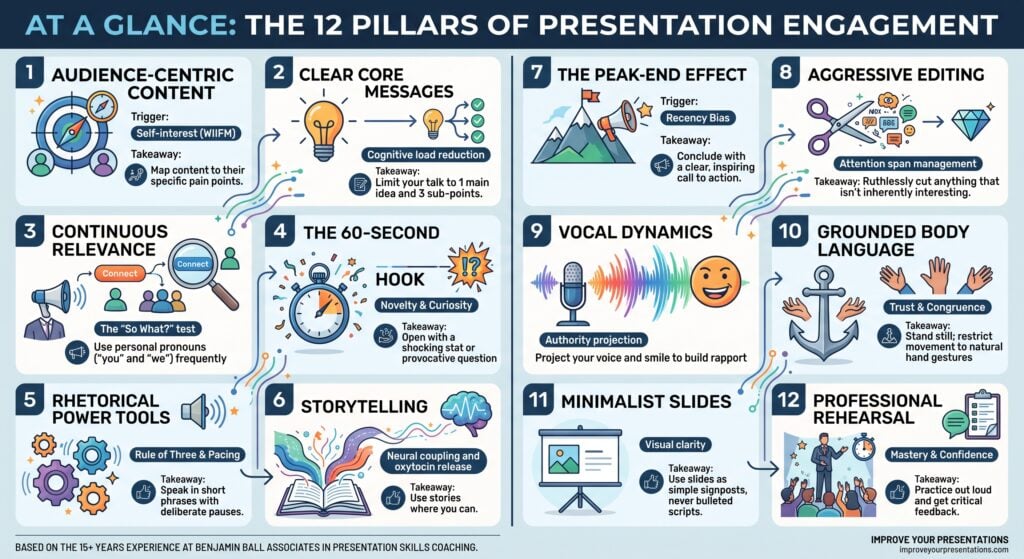
At a Glance: The 12 Pillars of Presentation Engagement
| Engagement Strategy | Core Psychological Trigger | Actionable Takeaway |
| 1. Audience-Centric Content | Self-interest (WIIFM) | Map content to their specific pain points. |
| 2. Clear Core Messages | Cognitive load reduction | Limit your talk to 1 main idea and 3 sub-points. |
| 3. Continuous Relevance | The “So What?” test | Use personal pronouns (“you” and “we”) frequently. |
| 4. The 60-Second Hook | Novelty & Curiosity | Open with a shocking stat or provocative question. |
| 5. Rhetorical Power Tools | Rule of Three & Pacing | Speak in short phrases with deliberate pauses. |
| 6. Storytelling | Neural coupling and oxytocin release | Use stories where you can |
| 7. The Peak-End Effect | Recency Bias | Conclude with a clear, inspiring call to action. |
| 8. Aggressive Editing | Attention span management | Ruthlessly cut anything that isn’t inherently interesting. |
| 9. Vocal Dynamics | Authority projection | Project your voice and smile to build rapport. |
| 10. Grounded Body Language | Trust & Congruence | Stand still; restrict movement to natural hand gestures. |
| 11. Minimalist Slides | Visual clarity | Use slides as simple signposts, never bulleted scripts. |
| 12. Professional Rehearsal | Mastery & Confidence | Practice out loud and get critical feedback |
Get a free quote. Speak to an expert
12 Actionable Audience Engagement Techniques
1. Design Your Presentation Specifically for Your Audience
Your guiding mantra must always be: audiences are selfish. They care about their own problems, timelines, and goals. You cannot engage an audience you haven’t taken the time to understand.
Before opening your laptop, ask yourself:
- What are their primary operational or financial pain points?
- What is their existing level of knowledge on this exact topic?
- What is their preferred communication style?
Consider how you need to tailor for different audiences:
- Presenting to the Board: Executives are protective of their time. They want to know what decision is required, the quantified risks, and the financial implications. Keep it brief and hit the point immediately.
- Presenting to the Sales Team: Sales professionals are independent and results-driven. They want to know how you will make their lives easier and boost their commissions. Keep the energy upbeat, practical, and highly targetted on commercial upside.
2. Limit Your Presentation to a Few Core Messages
A common presentation mistake is trying to squeeze every piece of available information into a single session. This is incredibly common in regular operational reporting. For example, if you are delivering a quarterly financial update, your job is to explain what the numbers mean, not just repeat the data on the screen.
The Magic Formula: Summarise your entire presentation into one overarching core message supported by a maximum of three clear pillars. If a detail doesn’t support those pillars, remove it.
3. Answer “So What?” and “WIIFM” Continuously
Picture a cynical, bored decision-maker sitting in the back row with their arms crossed. Throughout your talk, they are mentally asking you two questions: “So what?” and “What’s in it for me (WIIFM)?”
Force yourself to answer these questions explicitly after every data point you share.
An easy shortcut to maintain this is to lean heavily on the personal pronouns “you” and “we” rather than endlessly saying “I” or “our company.”
4. Hook Your Audience Within the First 60 Seconds
Your presentation is won or lost in the opening moments. A dull introduction like “Good morning, my name is Ben, and today I’m going to talk about…” signals to the audience’s brains that it is safe to check their emails.
Instead, master a few proven opening techniques to start a presentation with impact, ensuring the room is locked into your message from the very first sentence. Use one of these four strategic hooks:
- The Provocative Question: Prompt immediate internal reflection from the room.
- The Compelling Statistic: Introduce a shocking, counter-intuitive data point that disrupts assumptions.
- The Narrative Hook: Dive straight into the middle of a high-stakes client story.
- The Future Vision: Immediately paint a picture of a major industry problem completely solved.
With a great start, the rest of your presentation will be much more engaging.
Need to Transform Your Team’s Presentation Skills?
At Benjamin Ball Associates, we deliver fast, highly effective coaching for individuals and corporate teams. Whether you need presentation coaching, public speaking coaching or hands-on pitch support, we help you win the room.
Call Louise Angus on +44 20 7018 0922 or email info@benjaminball.com to get a free quote today.
5. Deploy Spoken Power Language
Classical rhetoric is rarely taught in modern business settings, yet it remains the foundation of charismatic leadership. To bring your spoken narrative to life, inject these linguistic tools:
- The Rule of Three: Human brains love information delivered in trios (e.g., “Clear, simple, compelling”).
- Short Phrases: Break up long, winding sentences into crisp, distinct punches.
- Deliberate Pauses: Let key statements hang in the air for a moment so their importance settles in.
- Analogies and Metaphor: Simplify highly technical mechanisms by comparing them to everyday concepts.
6. Tell Stories
Stories are so much more engaging than facts.
If you have facts you want to get across, see how you can wrap them up into a story.
Try this simple formula for powerful storytelling:
- Situation – Who, what, where
- Complication – What challenges were faced
- Resolution – How were the challenges overcome
- So What – Remind us what this story means.
Here’s a story from Steve Job’s Stamford Commencement Speech that uses that formula:
| Story Part | Text |
|---|---|
| Situation | 17 years later, I did go to college, but I naively chose a college that was almost as expensive as Stanford, |
| Complication | and all of my working class parents savings were being spent on my college tuition. After six months, I couldn’t see the value in it. I had no idea what I wanted to do with my life and no idea how college was going to help me figure it out, and here I was spending all the money. My parents had saved their entire life, so I decided to drop out and trust that it would all work out. |
| Resolution | Okay. It was pretty scary at the time, but looking back, it was one of the best decisions I ever made. The minute I dropped out, I could stop taking the required classes that didn’t interest me and begin dropping in on the ones that looked far more interesting. |
| So What | [this comes later in the speech] |
Use this simple storytelling structure to make your presentations more engaging.
7. Leverage the Peak-End Effect for a Powerful Close
In behavioural psychology, the Peak-End Effect proves that humans judge an experience primarily based on how it felt at its peak and how it ended. Consequently, your closing words are vital for long-term retention.
Never end a talk with a flat, passive “So, yeah, that’s about it from me.” Structure your conclusion with two distinct components: a concise recap of your three core pillars, followed immediately by an inspiring conclusion or an explicit call to action.
8. Ruthlessly Edit Out Anything Slightly Boring
Engaging presentations are built entirely in the editing phase.
Adopt the strict professional standard of saying something genuinely interesting or highly relevant at least every ten words. If a slide, an anecdote, or a metric fails this test, cut it out entirely or find a fresh way to reposition it. If the audience is bored, they stop listening.
Make sure you are saying something interesting at least every 12 words.
9. Upgrade Your Vocal Delivery Skills
Once you have written a tightly structured presentation, you must use your voice as an instrument to deliver it effectively. Work on three immediate public speaking delivery tips:
- Vocal Projection: Speak slightly louder and with more deliberate emphasis than you would in a standard conversation.
- Rhythmic Pacing: Insert a clean pause every 5 to 10 words to add gravitas and give your audience time to process what you are saying.
- Warmth: Smile when appropriate. Psychological studies show that speakers who smile are perceived as significantly more authoritative and approachable.
10. Master Confident, Grounded Body Language
Your audience judges your credibility with their eyes long before they evaluate it with their ears. If your body language contradicts your spoken words, the audience will instinctively doubt your message.
- Stand Still: Plant your feet firmly. Avoid nervous pacing, swaying, or shifting your weight from side to side. Confine your movement to the upper half of your body.
- Direct Eye Contact: Pick individuals around the room and look at them for the duration of a complete thought.
- Open Gestures: Use your hands naturally to emphasise scale, contrast, or conviction. Keep your hands out of your pockets and away from your hips.
11. Optimise Your Slide Decks and Visual Aids
One of the fastest ways to lose an audience is to present them with complex, text-heavy slides. If your audience is forced to read walls of text on a screen, they will completely stop listening to your voice.
Your operational formula for clean visual design should be:
- A Descriptive Title: State the exact takeaway message right at the top of the slide.
- Minimalist Evidence: Include just enough visual information (such as a clean chart or image) to prove that single statement.
- Zero Bullets: Treat bullet points as a symptom of an unedited script. Keep it visual.
12. Practice and Rehearse Like a Professional
Presenting is a technical, learned skill. Nobody is born a naturally gifted corporate presenter; elite speakers simply invest heavily in their training.
Practice your presentation completely out loud multiple times. Record yourself on video to analyse your pacing, and seek out brutal, constructive feedback from a coach or peer before stepping onto the stage.
Frequently Asked Questions
How do you keep an audience engaged during a dry or technical presentation?
The drier the subject matter, the more vital human emotion becomes. Avoid delivering an unedited data dump. Instead, use analogies to explain complex mechanisms, paint a vivid picture of a problem solved, and translate technical metrics into real-world benefits that directly impact the listener’s day-to-day operations.
What is the best way to interact with a presentation audience?
Shift your presentation from a rigid monologue into a structured dialogue. You can achieve this without losing control of the room by posing targeted rhetorical questions, encouraging immediate feedback on key points, and maintaining eye contact with individuals across the room.
Elevate Your Business Presentation Skills
Becoming an exceptionally engaging presenter requires work. After every meeting, evaluate what resonated, what fell flat, and where your physical delivery can improve.
If you want to fast-track your team’s development and maximise your impact in high-stakes meetings, let’s connect:
What you should do next
- For more articles like this, subscribe to our fortnightly newsletter
- Download some of our free expert guides
- Get in touch and discuss how our intensive presentation coaching and public speaking training courses can help you.
Call our client services director Louise Angus on + 44 20 7018 0922 or email info@benjaminball.com
Find out more.
Get a free quote. Speak to an expert
Why Choose Us:
Transform your pitches and presentations with tailored coaching

We can help you present brilliantly. Thousands of people in the UK, Europe and the Middle East have benefitted from our tailored in-house coaching and advice – and we can help you too.
“I honestly thought it was the most valuable 3 hours I’ve spent with anyone in a long time.”
Mick May, CEO, Blue Sky
For 15+ years we’ve been the trusted choice for leading businesses and executives throughout the UK, Europe and the Middle East. We’ll help you improve corporate presentations through presentation coaching, public speaking training and expert advice on pitching to investors. And we stand out because you benefit from our tried and tested PitchPointTM Process to make sure you make fast and lasting improvements.
Some recent clients

Unlock your full potential and take your presentations to the next level.
Speak to Louise on +44 20 7018 0922 or email info@benjaminball.com to transform your speeches, pitches and presentations.
Get a free quote. Speak to an expert
Infographic – How to engage an audience in your presentation
FAQ: How to Engage an Audience During a Presentation
1. Why is audience engagement important in a presentation?
Audience engagement ensures your message is remembered and acted upon. If your audience is not engaged, they are unlikely to absorb your key points or take the desired action. Engaging presentations create a lasting impact and make your communication more persuasive.
2. How can I connect emotionally with my audience?
To connect emotionally, use storytelling, emotive visuals, and relatable examples. Appeal to your audience’s values, beliefs, and aspirations. Talk about them and how what you are talking about will impact them.
People remember how you made them feel more than the exact words you used.
3. What role does storytelling play in audience engagement?
Stories make your presentation more compelling because they tap into emotions and make your message relatable. A well-told story will hold attention, illustrate key points, and make your content more memorable.
4. How do I tailor my presentation to my audience?
Understand your audience’s needs, motivations, and concerns. Adjust your language, tone, and content to resonate with their interests. If your audience values sustainability, for instance, highlight environmental aspects of your topic.
5. Why should I use visuals in my presentation?
Visuals help reinforce your message, make complex concepts easier to understand, and add emotional impact. Use images, metaphors, and well-designed charts to support your key points rather than cluttering slides with excessive text. Learn how to create a winning presentation.
6. What are rhetorical questions, and how do they help?
Rhetorical questions make your audience think and encourage active participation. They create curiosity and keep people engaged by prompting them to reflect on your message.
7. How can I use body language to engage my audience?
Use eye contact, animated gestures, and variations in vocal tone and pace to convey enthusiasm and confidence. A dynamic and expressive delivery keeps the audience interested and engaged.
9. How can I improve my presentation skills?
Improving presentation skills takes practice and expert coaching. Professional training, such as that offered by Benjamin Ball Associates, provides tailored guidance to help you engage your audience effectively.
10. How can Benjamin Ball Associates help with presentation coaching?
Benjamin Ball Associates has over 15 years of experience coaching business leaders to improve their public speaking and presentation skills. Our presentation skills coaching is fast, effective, and tailored to your needs.
What you should do next
- For more articles like this, subscribe to our fortnightly newsletter
- Download some of our free expert guides
- Get in touch and discuss how our intensive presentation coaching and public speaking training courses can help you.
Call our client services director Louise Angus on + 44 20 7018 0922 or email info@benjaminball.com
Find out more.
Get a free quote. Speak to an expert
Speak to Louise on +44 20 7018 0922 or email info@benjaminball.com to transform your speeches, pitches and presentations.
Related Posts


Read our ultimate guide to compelling business presentations
Contact us now for free consultation
Start improving your pitches and presentations now
Contact us now and speak to an expert about getting award-winning coaching, training and advice