

How to Prepare a High-Stakes Business Presentation – Your 3-Phase Process
January 25, 2024
Updated 30 May 2026
When the stakes are high, you need to get your presentation right. Whether presenting to a board, a client, a conference or your company, you need more than generic tips. You need expert advice that will make sure you land the results you want.
At Benjamin Ball Associates we’ve spent 15 years preparing high-stakes presentation for business leaders. From some of the biggest fundraising events to conference speeches and capital markets days, many of the largest firms rely on our coaching to get them ready. How can Presentation Skills Coaching from Benjamin Ball Associates help you?

Meet the Author: Benjamin Ball
Ben is the founder of London-based Benjamin Ball Associates. He leads the presentation coaching and pitch deck creation teams. Formerly a corporate financier, for 20+ years he’s helped businesses pitch, present & persuade. He is a guest lecturer at Columbia Business School, Imperial College and UCL London. Follow Ben on LinkedIn or visit the contact page.
Why So Many High-Stakes Presentations Fail (And How to Fix Yours)
Think about the last truly great business presentation you saw. Chances are, it stood out because it was clear, compelling and memorable. But most presentations blend into a forgettable haze of bullet points and promotion.
The truth? 90% of business presentations fail to achieve their goal, whether that’s securing a deal, aligning a team, or inspiring action. The reason isn’t a lack of expertise; it’s a lack of proper preparation.
What Makes a Powerful High-Stakes Presentation?
A powerful presentation isn’t about fancy slides or charismatic delivery (though those help). It’s about strategy, structure and storytelling—knowing exactly what your audience needs to hear and delivering it in a way that sticks.
Whether you’re pitching to investors, updating stakeholders or leading a team meeting, the difference between a presentation that lands and one that flops comes down to how you prepare. Below, we break down the three key steps to create a high-stakes presentation that gets results.
How to Go About Creating a Winning High-Stakes Presentation
For an important high-stakes presentation, you should follow a process. This is the process that our team has developed over the last 15 years – and it works. It has three phases:
Phase 1: The Pre-Draft Strategy (see steps 1-3)
Phase 2: Structuring Your Narrative (steps 4-8)
Phase 3: Polishing and Performance (steps 9-13)
How to Prepare High-Stakes Business Presentations – 13 steps
1. Close PowerPoint and plan on paper

PowerPoint is terrible for planning business presentations. Creating slides for a PowerPoint presentation first is the biggest presenting mistake we see (and frequently it wastes a lot of valuable time).
“PowerPoint makes us stupid.”
— General James Mattis, US Marine Corps
2. Really understand to whom you are speaking

To prepare properly, you need to know your target audience. For example, you might be addressing just 10 people in an audience of 1000
Or you might want everyone in the room to change their behaviour slightly. The more tightly you define your objective, the greater your chance of success. For example, when you present to the board, you need to confider what is important to them and that they are busy people with a lot on their plates.
To really understand your audience, stand in their shoes. Ask yourself:
– Why are they coming?
– What’s on their mind?
– What concerns do they have?
– What ideas will resonate with them?
– What language will they recognise?
– What are the main points they expect?
The better you understand your audience, their fears, concerns and desires, the more focused you will be and the more confident you can be that you will address their concerns. And you’ll be better at grabbing and maintaining your audience’s attention.
“If you don’t know what your audience cares about, you’ve already lost them.”
— Carmine Gallo, Communication Expert and Author
3. Have a single clear message that you want to hammer home

Distil what you want to say into a single sentence. This is probably the hardest aspect of planning a powerful business presentation, but it is also a key first step in creating a winning high-stakes presentation.
This phrase should encapsulates your presentation. Avoid vague statements like “I want to tell them about our new product” The sharper your message, the better.
Imagine someone in your audience being asked after your presentation, ‘What was that presentation about?’ If you know exactly what they will answer, you have a brilliant presentation. Read more about the So What Test.
You can always use our messaging cracker process to create powerful messages for effective business presentations.
“If you can’t write your message in a sentence, you can’t say it in an hour.”
— Dianna Booher, Communication Expert
4. Use a winning presentation structure
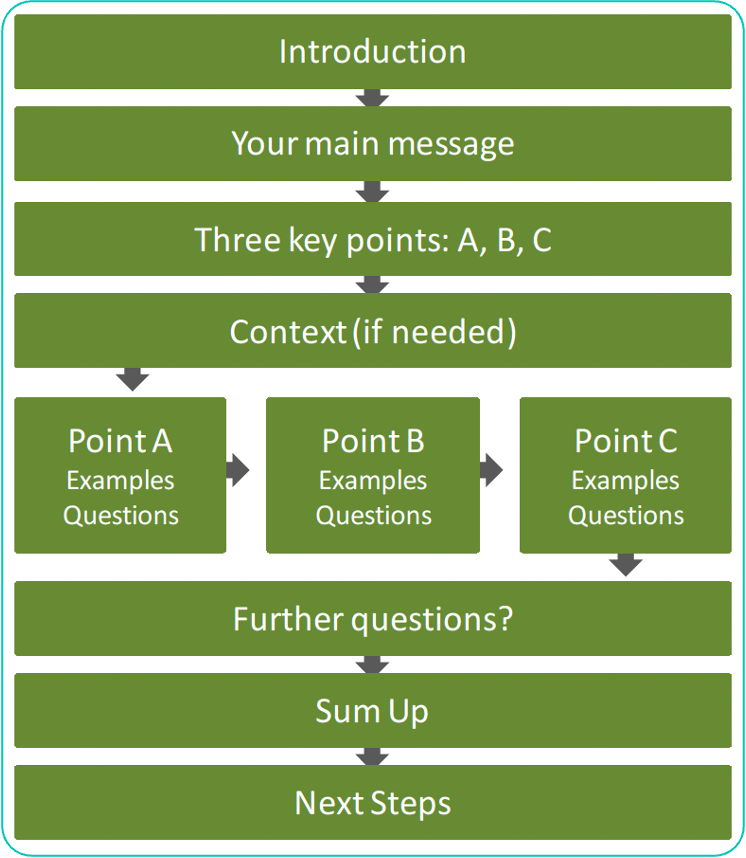
A three part structure is often the most effective. For each part of your presentation, have a clear message. You need a strong start to your presentation. Then three key parts to your presentation. Then finish with a powerful end.
“No one remembers a long list of facts. Divide your content into clear, digestible chunks.”
— Nancy Duarte, Presentation Expert and Author
5. Make the start of your presentation stand out

Work out something that will make people sit up and listen. Tell them what you are going to tell them. Get them excited. Learn more here about how to start a presentation with impact.
“The first 10 seconds of your speech are the most important. They set the stage for everything that follows.”
— Scott Berkun, Author of Confessions of a Public Speaker
6. Use stories, anecdotes and examples

Learn how to use stories in your business presentations. Find ones to support your messages.
The more you illustrate what you want to say with a real story, the more powerful your presentation becomes. The best stories are personal real life examples. And bring it to life with memorable phrases.
“Stories are the single most powerful weapon in a leader’s arsenal.”
— Dr. Howard Gardner, Psychologist and Professor at Harvard University
7. Finish with something that will always be remembered

What you say last will be remembered best. This could be a call to action. A memorable phrase. Or it could be a famous quote. Here are some tips about ending your presentation effectively.
“Your closing is the parting impression you leave with your audience. Make it powerful.”
— Patricia Fripp, Speaker and Presentation Skills Expert
8. Use the clearest, simplest language you can

Cut out all jargon or corporate speak. Your presentation skills training should teach you some basic elements of rhetoric which will bring life to your presentations and make it easy for you to engage your audiences.
Learn about Power Language and how to use it in your presentations. For example, rhetorical questions, metaphor and story telling are some of the many tools you can apply towards presentation success.
“If you can’t explain it simply, you don’t understand it well enough.”
— Albert Einstein
9. Incorporate pauses, short sentences and great eye contact

A presentation is a performance. If you look and sound good there is a better chance of success in your presentation.
Non-verbal communication and body language play a crucial role in how your message is perceived. Maintain eye contact, use gestures and vary your tone to convey enthusiasm and confidence.
Pausing at key moments can also give your audience time to digest information. You will also look and sound more confident when you present. Discover the Power of the pause in presentations.
“The pause is as important as the word.”
— Unknown
10. Work out what questions you could be asked

When preparing important business presentations, you need to dedicate time to preparing answers to potential questions. Practice how you will answer questions using tried and tested question answering techniques.
Don’t just leave it to a Q&A session. Perhaps answer questions throughout your presentation.
“I would rather have questions that can’t be answered than answers that can’t be questioned.”
— Richard Feynman
11. Now, decide out if you really need any visual aids or handouts

You may now decide that some charts, diagrams or pictures will help get your message across even more powerfully. If you do use these in your presentation, make sure you use best practice for preparing your visuals, slides and charts.
“PowerPoint is like a crutch; you can lean on it, but it won’t make you walk.”
— Unknown
12. Practise, practise, practise – and practise again
You will only take your skills to the next level by practising your important presentation. The best business presentation training will show you a method and process so that you continue to improve after your training.
For example, you could use a knowledgeable audience or record yourself on camera to refine your performance and to set up a feedback loop.
“The more I practise, the luckier I get.”
— Gary Player, Professional Golfer
13. Seek feedback and improve
After your presentation, gather feedback from trusted colleagues or audience members.
Constructive criticism will give you valuable insights to help you refine your skills for future presentations. Continuous improvement is key to becoming a more effective presenter.
When you work with a presentation coach, you’ll find it much easier to get constructive feedback that will speed you on your way to success.
If you want to learn about the business presentation training workshops we run, call us today
Give A Winning Presentation – A Summary
Creating a powerful high-stakes presentation is essential for any business owner, leader or executive looking to report information, get things done, secure funding or attract new clients.
This is your opportunity to convey your ideas succinctly and engage your audience from the outset.
In a typical business presentation, clarity is key. Create a compelling narrative. Don’t rely on bullet points. You need to break down complex concepts into easily digestible segments.
Final Presenting Tip
Remember, you don’t need slides to make a good impression. The best way to present is to make a good impression by being properly prepared.
By following these expert tips, you can turn a standard presentation into a successful event that captures the attention of stakeholders and propels your business forward.
How Presentation Training Will Improve your Presenting Skills
At Benjamin Ball Associates we’ve spent over fifteen years supporting major organisations with important communications. We work with leaders from all types of businesses helping them transform their communications.
We can help with:
- One-to-one presentation coaching online
- Group presentation coaching in-house
- Advice to improve a particular pitch or presentation
Working with us, you get practical, easy-to-implement advice that helps you grab attention, make an impact and remain memorable. We build skills, effectiveness and confidence – and we do this every day.
Call our Client Services Director, Louise Angus on +44 (0)20 7018 0922 or email info@benjaminball.com to discuss how we can help you today.
Get a free quote. Speak to an expert
What you should do next
- For more articles like this, subscribe to our fortnightly newsletter
- Download some of our free expert guides
- Get in touch and discuss how our intensive presentation coaching and public speaking training courses can help you.
Call our client services director Louise Angus on + 44 20 7018 0922 or email info@benjaminball.com
Find out more.
Get a free quote. Speak to an expert
Why Choose Us:
Transform your pitches and presentations with tailored coaching

We can help you present brilliantly. Thousands of people in the UK, Europe and the Middle East have benefitted from our tailored in-house coaching and advice – and we can help you too.
“I honestly thought it was the most valuable 3 hours I’ve spent with anyone in a long time.”
Mick May, CEO, Blue Sky
For 15+ years we’ve been the trusted choice for leading businesses and executives throughout the UK, Europe and the Middle East. We’ll help you improve corporate presentations through presentation coaching, public speaking training and expert advice on pitching to investors. And we stand out because you benefit from our tried and tested PitchPointTM Process to make sure you make fast and lasting improvements.
Some recent clients

Unlock your full potential and take your presentations to the next level.
Speak to Louise on +44 20 7018 0922 or email info@benjaminball.com to transform your speeches, pitches and presentations.
Get a free quote. Speak to an expert
FAQ: How to Give a Powerful High-Stakes Business Presentation
1. How long should a business presentation be?
The shorter the better!! No longer than 15–20 minutes, leaving time for Q&A. Research shows attention spans drop sharply after 18 minutes (similar to TED Talks). For investor pitches, 10–12 slides max. Need help condensing? Our coaching streamlines content without losing impact.
2. Should I use slides in every presentation?
No. Slides should support your message, not replace it. Many persuasive presentations (e.g., Steve Jobs’ iPhone launch) used minimal visuals. Follow our Step 11 to decide if slides add value. Tip: If your slides work as a standalone doc, you’re doing it wrong.
3. How can I calm my nerves before presenting?
Practice aloud 5+ times (Step 12).
Pause and breathe (Step 9) to reset.
Think about audience needs (Step 2), not yourself.
Our coaching clients reduce anxiety by 80%+ with tailored techniques.
4. What’s the #1 mistake presenters make?
Starting with PowerPoint (Step 1). Slides ≠ your presentation. Build your story and strategy first, then design visuals if needed. Example: A client cut 80% of their slides after our coaching—and won the deal.
5. How do I handle tough questions?
Anticipate them (Step 10) and rehearse answers.
Use the “Bridge” technique: “Great question. What’s critical to remember is…”
We train clients to turn Q&A into a persuasive tool—contact us to learn how.
6. Can I improve my presentation skills quickly?
Yes. Work on:
A single message (Step 3).
Strong open/close (Steps 5 & 7).
1–2 storytelling examples (Step 6).
Our 3-hour coaching sessions often transform clarity and confidence.
7. Why hire a presentation coach?
Even CEOs use coaches. Benefits:
Objective feedback (Step 13) on content/delivery.
Custom frameworks for your industry (e.g., investor pitches vs. internal updates).
Confidence boosts via proven techniques.
Result: All our clients see immediate and lasting improvement. Call us to discuss your goals.
What you should do next
- For more articles like this, subscribe to our fortnightly newsletter
- Download some of our free expert guides
- Get in touch and discuss how our intensive presentation coaching and public speaking training courses can help you.
Call our client services director Louise Angus on + 44 20 7018 0922 or email info@benjaminball.com
Find out more.
Get a free quote. Speak to an expert
How to prepare your next presentation
Related Posts


Contact us now for free consultation
Start improving your pitches and presentations now
Contact us now and speak to an expert about getting award-winning coaching, training and advice