

How To Write a Business Speech – 10 Expert Speech Writing Tips for Leaders
August 23, 2024
Updated 27 August 2026
A business speech that lands can shift opinions, inspire action or define a career moment. A speech that falls flat gets politely forgotten.
This guide on how to write a business speech gives you the structure, techniques and practical examples to write speeches people remember—whether you’re preparing a keynote, a leadership address or a high-stakes business presentation.
At Benjamin Ball Associates, we’ve spent more than 15 years writing, editing and coaching speeches for CEOs, board members and senior leaders. The advice below comes directly from our public speaking coaching.

Meet the Author: Benjamin Ball
Ben is the founder of London-based Benjamin Ball Associates. He leads the presentation coaching and pitch deck creation teams. Formerly a corporate financier, for 20+ years he’s helped businesses pitch, present & persuade. He is a guest lecturer at Columbia Business School, Imperial College and UCL London. Follow Ben on LinkedIn or visit the contact page.
How Do You Write a Speech That Works?
A strong speech does three things:
- Connects — The audience feels the speaker understands them
- Clarifies — Complex ideas become simple and memorable
- Moves — The audience thinks, feels or acts differently afterward
Most weak speeches fail on all three. They talk at the audience rather than to them. They bury the message in jargon. They end without giving anyone a reason to care.
The good news: these problems are fixable. Speech writing is a craft, and craft can be learned.
The Core Speech Writing Principle: Logic and Emotion Together
Here’s the most important thing to understand about speech writing and persuasion:
Logic alone does not convince. Emotion alone does not convince. You need both.
Aristotle identified this 2,500 years ago. He said persuasion requires three elements:
| Greek | English | In practice |
| Logos | Logic | Facts, data, clear reasoning |
| Ethos | Credibility | Why should they trust this speaker? Is the speaker helping me? |
| Pathos | Emotion | Stories, images, language that moves people |
A speech built only on logic becomes a spreadsheet. A speech built only on emotion feels manipulative. The best speeches weave all three together—and that’s what makes speech writing both challenging and rewarding.
CASE STUDY – Writing A Powerful Start to a Speech
A few years ago we helped the COO of a large utility company transform his public speaking skills. He had to give the annual health & safety lecture to his top team. He knew they would not listen unless he did something different. This was how he started his speech:
“Early in my career, I was put in charge of a building site. In my first week there, we had a crane collapse.
“That night, I had to knock on the door of a house and tell a woman that her husband had been killed on a site where I was in charge.
I never want any of you to have to go through what I went through that day. And that’s why we’re talking about health and safety today.”
As a result everyone was listening and wanted to hear more.
Get a free quote. Speak to an expert
How to Write a Business Speech – Speech Writing Tips
How to Write a Speech – Top Tips
Let’s review each of these speech writing tips in more detail and explore how you can use each of these to create better speeches:
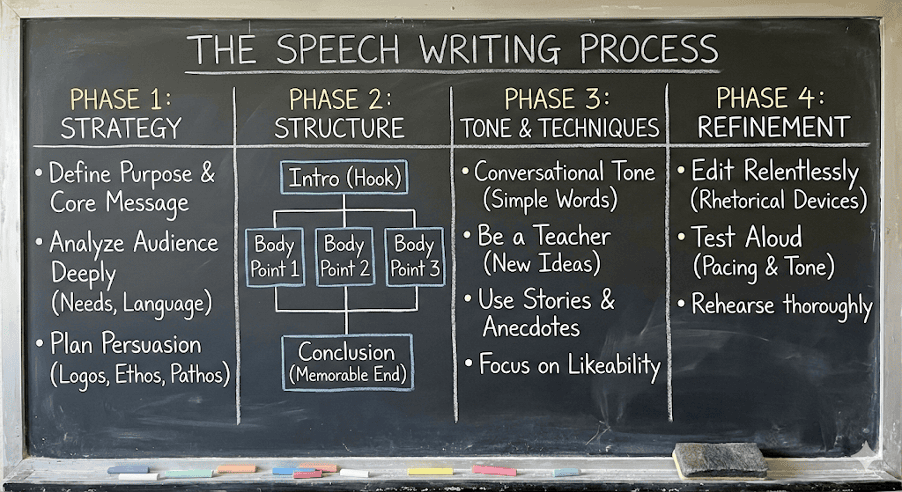
1. Practical steps to write a good business speech
Writing a great speech starts with a clear plan. Here’s a plan you can use:
- Define your purpose—are you informing, persuading, or entertaining?
- Know your audience to tailor your tone and examples
- Research your topic thoroughly to build credibility
- Write first a 1-paragraph summary, then an outline, finally a longer text
- Structure your speech with a
- strong introduction (hook your audience)
- a body (organised into 3 main points with supporting evidence)
- memorable conclusion (reinforce your message).
- Write conversationally, using short sentences and vivid language.
- Finally, practice aloud to refine pacing and tone.
- Revise as needed and consider timing—speeches should be concise.
With these steps, you’ll craft a speech that engages and resonates.
2. Understand what weak speeches do vs. what strong speeches do
| Weak speeches | Strong speeches |
| Open with “Thank you for having me”/”My name is” | Open with a story, question or bold claim |
| Try to cover everything | Built around one clear message |
| Use formal, complex language | Sound like a smart person talking |
| End with “Any questions?” | End with a memorable line or call to action |
| Rely on slides to carry the content | Let the speaker carry the content |
| Talk at the audience | Talk with the audience |
3. Really know your audience
Speeches are written for the audience first. Every speech fails or succeeds based on how well it fits its audience. Before you write a word, ask:
- Why are they here? What do they expect?
- What do they already know? What’s new to them?
- What do they care about? What worries them?
- What language do they use? What metaphors resonate?
The more precisely you can answer these questions, the more precisely your speech will land.
Example: Speaking to engineers? Open with a technical problem they’ll recognise. Speaking to a sales team? Lead with a revenue story. The same core message might need completely different framing for different rooms.
4. Use a simple speech structure
If you’re not sure where to start, use this framework which is ideal for most business speeches:
| Section | Purpose | Typical length |
| Hook | Grab attention | 30–60 seconds |
| Context & key messages | Why this matters to this audience & messages | 1–2 minutes |
| Main point 1 | First key idea, with evidence or story | 3–5 minutes |
| Main point 2 | Second key idea | 3–5 minutes |
| Main point 3 | Third key idea | 3–5 minutes |
| Takeaway | What you want them to remember or do | 1–2 minutes |
| Close | Memorable final moment, ideally emotional | 30 seconds |
Three main points is a guideline, not a rule. Some speeches need two; some need four. But if you’re reaching for five or six, you’re probably trying to say too much.
One of my favourite pieces of advice is from Winston Churchill who shared his process for writing speeches:
- A strong beginning
- One tight theme
- Simple language
- Word pictures e.g. “Iron curtain”
- Emotional ending
- Editing
5. Write your speech in stages
One big mistake that many people make is they sit down and try to write their speech from beginning to end.
Instead, we recommend you follow this tried and tested process which you can work on over a few days or even weeks:
- Write your main message in one line
- Expand this into one paragraph
- Now create a one page outline of your speech
- Start writing each section separately. So that if you have a 20 minute speech, each of your three main sections may be only 5 or 6 minutes long (600-900 words)
- Write the opening
- Write the end
- Edit ruthlessly
6. Make the speaker likeable—fast
Audiences listen to people they like. They tune out people they don’t. You have less than 60 seconds to establish warmth and connection.
Three ways to do it:
- Find common ground. Shared experiences, shared challenges, shared values. “Like you, I’ve sat through compliance training wondering if it would ever end…”
- Show humanity. A moment of self-deprecation, a personal detail, an admission of imperfection. Perfect speakers feel distant; human speakers feel trustworthy.
- Signal that you understand them. Reference their world, their concerns, their language. When they hear their own thoughts reflected back, they lean in.
See how Mohammed Qahtani won the Toastmasters World Championship of Public Speaking by endearing himself with his audience.
7. Get them nodding early
Before you challenge your audience, earn their agreement. Open with statements they already believe. Build momentum with ideas they recognise.
This isn’t manipulation—it’s respect. You’re showing that you understand their starting point before asking them to move somewhere new.
For example: A great opening line could be “As we all know…”
Get a free quote. Speak to an expert
8. Write like you talk
The best speeches sound like a smart person talking, not a document being read aloud.
- Short sentences
- Simple words
- Conversational rhythm
| Weak Speech Writing: | Strong Speech Writing: |
| “It is imperative that we leverage our collective capabilities to address the challenges that lie ahead.” | “We need to work together. The next year will be hard. Here’s how we’ll get through it.” |
PRO TIP: Read your draft aloud. If it sounds stiff, rewrite it. If you stumble over a phrase, simplify it. Your speech should feel natural in your mouth.
9. Make the complicated simple
Your audience cannot retain complexity. They will remember one idea, maybe two. Everything else disappears. Aim for big ideas expressed with small words.
This means your job is simplification:
- What is the single core message?
- Can you say it in one sentence?
- Can you say it in words a teenager would understand?
The test: If your audience were asked tomorrow, “What was that speech about?”—what would they say? If you don’t know, you haven’t simplified enough.
10. Teach, don’t preach
Audiences resist being lectured. They resent being sold to. But they love learning something new.
Frame your speech as a gift of insight, not a demand for agreement. Help them see the world differently. Give them something they didn’t know before.
Ask yourself:
- What can I teach them?
- What will they know afterward that they didn’t know before?
- What’s the “aha” moment?
If your audience leaves feeling smarter, they’ll remember you fondly.
11. Use stories, not just facts
“Facts get forgotten. Stories get repeated.”
A well-chosen story can:
- Make abstract ideas concrete
- Create emotional connection
- Be remembered years later
Stories work because they’re how humans naturally process information. A statistic about workplace safety is forgettable. A story about knocking on a widow’s door stays with you forever.
Story structure that works:
- Situation — Set the scene briefly
- Complication — What changed? What went wrong or right?
- Resolution — How were the problems fixed?
- Lesson — What did it teach us?
You don’t need epic tales. A 60-second anecdote from your own experience often works better than a polished case study. See the case study above.
12. Use vivid language
The real art of speech writing happens when you start using more powerful language. The great thing about rhetorical tools is that they are tried and tested, and you can feel confident that they will make your words more impactful.
Here are some of the most useful tools you can use:
| Rhetorical Tool | Example |
|---|---|
| A puzzle or problem | Many speeches that we hear are dull. Let’s fix that. |
| Sets of three | A government by the people, of the people, for the people |
| Rhetorical questions | What is the best way to write a speech? Let me show you. |
| Contrasting pairs | Many speeches are boring. Your speech will be great. |
| Metaphors, similes and analogies | A speech without rhetorical tools is like a curry without spices. |
| Short words and phrases | This won’t impact you. This won’t impact me. But this will impact all our children. |
| Personal pronouns | I really want you all to become great at speech making. |
And don’t worry about over-using these tools. Most people don’t use them enough. You can always cut them back later in the editing stage.
13. Craft your opening to win your audience
You have 30 seconds to earn the next 10 minutes. Don’t waste that opening on “Thank you for having me” and “It’s great to be here.”
Openings that work:
- A story: “Last year, I got a phone call that changed everything…”
- A surprising fact: “Half the people in this room will change careers in the next five years.”
- A question: “When was the last time you changed your mind about something important?”
- A bold statement: “Everything you’ve been told about productivity is wrong.”
The goal is simple: make them want to hear what comes next.
14. End with a call to action
A strong close is as important as a strong open. Your ending is what lingers.
Endings that work:
- Circle back to your opening story or image
- A clear call to action: “Here’s what I’m asking you to do…”
- A memorable final line they’ll carry with them
Endings that fail:
- “So, yeah… that’s about it.”
- “I think I’m out of time.”
- “Any questions?”
Write your last line. Memorise it. Deliver it with conviction. Then stop. Thank you. Let the silence land.
15. Edit relentlessly
The first draft is never the final draft. The real craft of speech writing happens in revision. The more you change, the better your speech will be.
Your word choice and how you use rhetorical devices can help you here. For example, by using rhetorical questions, sets of three, clear contrasts and metaphor, your words are more likely to resonate with your audience.
See this photo of Obama working on a script by speech writer John Favreau. Photo from The White House’s official Flickr account.

Your editing checklist:
- Read it aloud. Does it sound natural?
- Time it. Is it the right length?
- Cut anything that doesn’t serve the core message or is boring.
- Strengthen the opening and closing
- Check for jargon, clichés, filler phrases
- Rehearse in front of someone. Watch their reactions.
Every unnecessary word dilutes your impact. Say something interesting every 5-10 words. Cut until it hurts, then cut a little more.
How to Write a Great Business Speech – Next Steps
The tools above will all help.
- Your speech must be simple.
- Your speech must be engaging.
- You need to include case studies and stories to bring it to life.
Of course, speech writing is not easy. If it were, our firm would not exist. Every day we help people create compelling speeches and presentations. With advice and coaching we add value by making speeches compelling.
We’ve been transforming speeches for 15 years and we do it for some of the most successful businesses in the world. Call and learn more about how to write a speech and our public speaking training.
Get a free quote. Speak to an expert
Why Leaders Choose Us to Write Their Speeches
Clear thinking. We help you cut through noise and shape a message that lands first time.
Business-ready speeches. Your speech is designed for real audiences.
Senior-level support. You work with experienced consultants used to advising CEOs and leadership teams.
Delivery coaching included. We help you sound confident and natural when it matters most.
Proven results. For more than 15 years, leaders across the UK and Europe have trusted us with their most important messages.
Start your Journey to a Great Speech Today
If you want help making sure your next speech is outstanding, or to improve your speech writing skills, get in touch.
- We can help you draft and edit your speech
- We run intensive speech writing workshops – ideal if you want to learn the art and craft of speech writing.
- We can coach you to prepare and deliver a compelling speech.
Call Louise Angus, our client services director for a no obligation chat Click on the button below or call +44 20 7018 0922 or email info@benjaminball.com.
What you should do next
- For more articles like this, subscribe to our fortnightly newsletter
- Download some of our free expert guides
- Get in touch and discuss how our intensive presentation coaching and public speaking training courses can help you.
Call our client services director Louise Angus on + 44 20 7018 0922 or email info@benjaminball.com
Find out more.
Get a free quote. Speak to an expert
Why Choose Us:
Transform your pitches and presentations with tailored coaching

We can help you present brilliantly. Thousands of people in the UK, Europe and the Middle East have benefitted from our tailored in-house coaching and advice – and we can help you too.
“I honestly thought it was the most valuable 3 hours I’ve spent with anyone in a long time.”
Mick May, CEO, Blue Sky
For 15+ years we’ve been the trusted choice for leading businesses and executives throughout the UK, Europe and the Middle East. We’ll help you improve corporate presentations through presentation coaching, public speaking training and expert advice on pitching to investors. And we stand out because you benefit from our tried and tested PitchPointTM Process to make sure you make fast and lasting improvements.
Some recent clients

Unlock your full potential and take your presentations to the next level.
Speak to Louise on +44 20 7018 0922 or email info@benjaminball.com to transform your speeches, pitches and presentations.
Get a free quote. Speak to an expert
Business Speech Writing Tips From the Experts
This advice is based on our 15+ years of successfully supporting business people when they need to write and deliver a speech that makes a difference.
Where we stand out is that we write speeches, we edit speeches and we coach people to create and deliver impressive speeches. We work with leaders who need high-stakes speeches, we help simplify complex messages and we coach delivery as well as writing
FAQ: How to Write a Business Speech
How long should a speech be?
It depends on context. Most business speeches work best between 10 and 20 minutes. A keynote might run 20–45 minutes. A toast or introduction should be under 5. When in doubt, shorter is stronger—audiences remember tight talks, not long ones.
How do you start a speech to grab attention?
Learn great speech starts. Open with something that earns the next 30 seconds: a surprising fact, a vivid story, a bold statement, or a question that makes the audience think. Avoid throat-clearing (“It’s great to be here,” “I want to start by thanking…”). Get to the point fast.
What’s the best structure for a business speech?
A proven speech structure:
Hook – Grab attention in the first 30 seconds
Context – Why this matters to this audience
Three main points – Organised clearly, each with evidence or a story
Call to action or takeaway – What you want them to think, feel or do
Memorable close – End on a high; don’t trail off
Simple beats clever. If your audience can summarise your speech in one sentence afterward, you’ve succeeded.
How do you calm nerves before giving a speech?
Three practical techniques:
Breathe slowly. Long exhales activate your parasympathetic nervous system and reduce adrenaline.
Reframe the feeling. Nerves and excitement feel similar. Tell yourself you’re excited, not scared.
Prepare relentlessly. Confidence comes from knowing your material. Rehearse out loud, on your feet, until the opening feels automatic.
Should I memorise my speech or use notes?
Neither extreme works well. Memorising word-for-word sounds robotic and creates panic if you lose your place. Reading from a script kills connection. The best approach: know your structure and key phrases by heart, and keep brief bullet-point notes as a safety net.
How do you end a speech memorably?
End your speech with energy and emotion. Options that work:
Circle back to your opening image or story
Issue a clear call to action
Leave them with a single, resonant line
Avoid “So, yeah… that’s it” or “I think that’s all I have.” Finish strong, pause, and let the silence land.
What you should do next
- For more articles like this, subscribe to our fortnightly newsletter
- Download some of our free expert guides
- Get in touch and discuss how our intensive presentation coaching and public speaking coaching can help you.
Call our client services director Louise Angus on + 44 20 7018 0922 or email info@benjaminball.com
Find out more.
Get a free quote. Speak to an expert
Related Posts


Get a free quote. Speak to an expert
Read the Ultimate Guide to Public Speaking for Leaders
Contact us now for free consultation
Start improving your pitches and presentations now
Contact us now and speak to an expert about getting award-winning coaching, training and advice